Skip to content












































The rapid growth of cloud computing, artificial intelligence (AI), and high-performance data centers is transforming the way optical networks are designed and deployed. As data traffic continues to increase, network infrastructure must support higher bandwidth, faster transmission, and more connections within increasingly limited physical space. These demands are driving an important evolution in fiber optic connectivity: the transition toward smaller, more compact, and higher-density fiber optic connectors.
From traditional SC connectors to widely adopted LC and MPO/MTP solutions, and now to emerging Very Small Form Factor (VSFF) technologies such as MMC and SN-MT, connector design is evolving to accommodate the changing requirements of modern optical networks. This shift is not simply about reducing connector dimensions. It reflects a broader effort to maximize fiber capacity, improve space utilization, simplify cabling infrastructure, and prepare data centers for the next generation of high-speed connectivity.
1. Why Are Fiber Optic Connectors Becoming Smaller?
The demand for smaller fiber optic connectors is closely related to the increasing capacity requirements of modern communication networks. As data centers handle larger volumes of information, their switching equipment, servers, and optical transceivers must support more high-speed connections. However, the physical dimensions of network equipment and rack infrastructure cannot expand indefinitely.
This creates a fundamental challenge: how can network operators accommodate more optical connections without increasing the physical footprint of their infrastructure?
Connector miniaturization provides part of the answer. By reducing the space occupied by individual optical interfaces, manufacturers can increase the number of ports installed on equipment panels and patch panels. When combined with multi-fiber connector designs, this approach allows significantly more optical fibers to be accommodated within the same physical space.
Several factors are accelerating this development.
Increasing Bandwidth and Transmission Capacity
The evolution of Ethernet speeds from 10G and 25G to 100G, 400G, 800G, and beyond has changed the requirements for optical connectivity. Higher-speed network architectures often require more optical channels, greater fiber counts, or more efficient fiber utilization, depending on the transmission technology.
For example, parallel optical transmission uses multiple fiber channels to transmit and receive data simultaneously. As network speeds increase, multi-fiber connectors become increasingly important for connecting transceivers, switches, and structured cabling systems.
Traditional duplex connectors remain widely used for many applications, but connecting numerous individual duplex fibers can create a complicated cabling environment. Multi-fiber interfaces such as MPO/MTP consolidate multiple optical fibers into a single connector, making high-speed connections easier to deploy and manage.
Limited Space in Modern Data Centers
Space efficiency is another major factor behind connector miniaturization. Modern data center switches and servers are designed to accommodate more ports and higher processing capacity within standardized equipment dimensions. Consequently, the available space for optical interfaces becomes increasingly valuable.
A smaller connector allows more interfaces to fit within the same panel area. This improves port density and provides greater flexibility when designing high-density patch panels, optical distribution frames, and equipment interconnections.
The benefits extend beyond the equipment panel itself. More compact connectors can also help optimize cable routing, reduce congestion around connection points, and improve the overall organization of fiber infrastructure.
The Growth of AI and High-Performance Computing
AI data centers are accelerating the need for higher-density optical connectivity. Large GPU clusters require extensive connections between computing nodes, switches, and other network devices. These connections must support high data rates while maintaining low latency and reliable performance.
As AI infrastructure scales, the number of optical links within individual racks and across data center facilities continues to grow. Conventional connector solutions may become increasingly difficult to manage when connection density reaches very high levels.
This is one reason why VSFF connectors and advanced multi-fiber interfaces are receiving greater attention. Their compact designs help accommodate more optical connections within limited spaces, supporting the evolving requirements of AI and high-performance computing environments.
2. From Traditional Connectors to High-Density Designs
The development of fiber optic connectors has involved two closely related improvements: reducing the size of individual connector interfaces and increasing the number of fibers supported by each connector.
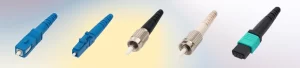
Traditional SC connectors provided reliable optical connectivity for telecommunications and enterprise networks. The introduction of LC connectors brought a smaller form factor, making it possible to accommodate more duplex connections in the same equipment space. Later, MPO/MTP connectors expanded this concept by integrating multiple fibers into a single interface.
Today, the industry is moving toward even more compact multi-fiber solutions, particularly for high-density data center applications.
The following table illustrates the general development of major connector families.
| Connector Type | Design Characteristics | Typical Fiber Configuration | Main Applications |
|---|---|---|---|
| SC | Traditional single-fiber interface | Simplex / Duplex | FTTH, telecom, enterprise networks |
| LC | Small Form Factor (SFF) | Simplex / Duplex | Data centers, switches, optical modules |
| MPO/MTP | Multi-fiber connector | 8F, 12F, 16F, 24F and more | Data center trunks, parallel optics |
| MDC | Very Small Form Factor (VSFF) | Duplex | High-density duplex connectivity |
| SN | Very Small Form Factor (VSFF) | Duplex | High-density data center connections |
| MMC | Multi-fiber VSFF | 12F, 16F, 24F configurations | High-density AI data center connectivity |
| SN-MT | Multi-fiber VSFF | Multi-fiber configurations | High-speed data center interconnects |
Note: Fiber configurations and product availability vary by connector design and manufacturer.
LC: A Major Step Toward Miniaturization
The LC connector became widely adopted because of its compact design and practical advantages in high-density optical connectivity. Using a 1.25 mm ferrule, compared with the 2.5 mm ferrules used in traditional SC connectors, LC connectors occupy less space while maintaining reliable optical performance.
This makes LC particularly suitable for duplex fiber connections in switches, transceivers, patch panels, and structured cabling systems. Even as newer connector technologies emerge, LC remains an important interface across enterprise networks and data center infrastructure.
MPO/MTP: Increasing Fiber Count Through Multi-Fiber Connectivity
While LC focuses on reducing the size of individual duplex interfaces, MPO/MTP connectors take a different approach by integrating multiple optical fibers into a single connector.
Depending on the design, MPO/MTP connectors can support 8, 12, 16, or 24 fibers and other configurations. This allows multiple optical channels to be connected through one interface, reducing the number of individual connections required for high-capacity cabling systems.
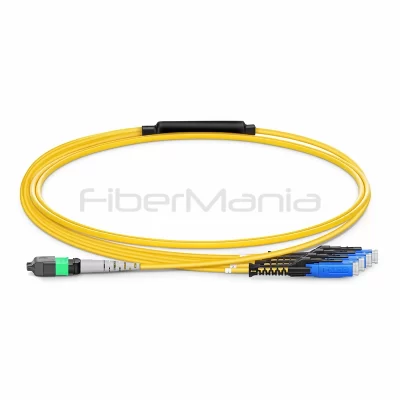
MPO/MTP trunk cables and harness cables are particularly important in structured data center cabling. They enable pre-terminated connections between patch panels, distribution systems, and network equipment, helping simplify installation and future network expansion.
MPO/MTP technology therefore remains a fundamental part of high-density fiber infrastructure, even as newer VSFF connector designs become available.
3. The Emergence of VSFF Connectors: Taking Miniaturization Further
The next stage of connector development is represented by Very Small Form Factor (VSFF) technology. Unlike conventional approaches that primarily increase fiber counts within larger multi-fiber connectors, VSFF designs aim to combine compact connector dimensions with high fiber capacity.
Examples include MDC, SN, MMC, and SN-MT connectors. These solutions are designed to address the growing need for more optical connections within limited equipment and patch panel space.
Among them, MMC and SN-MT are particularly interesting because they combine multi-fiber connectivity with a compact connector footprint.
MMC: Compact Multi-Fiber Connectivity
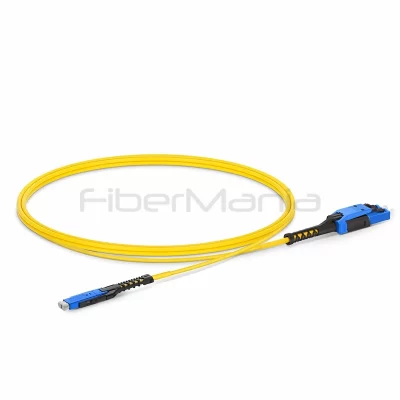
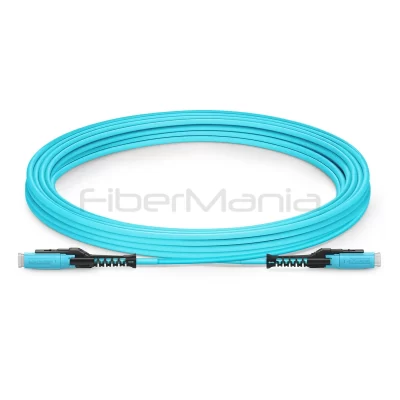
MMC (Miniature Multi-fiber Connector) is designed to support high-density optical connectivity in applications where space is limited. Using a compact multi-fiber ferrule structure, MMC can accommodate multiple optical fibers within a smaller connector interface than conventional MPO designs.
Depending on the configuration, MMC solutions support 12, 16, or 24 fibers. Their compact design makes them suitable for high-density patch panels, optical distribution systems, and advanced data center interconnections.
Some commercial MMC solutions are designed to provide up to three times the cabling port density of conventional MPO/MTP solutions within the same footprint, although actual density depends on the connector configuration and panel design.
SN-MT: Combining Compact Design with Multi-Fiber Performance
SN-MT is another emerging multi-fiber VSFF connector technology. It combines the compact form factor associated with SN connectivity with a multi-fiber alignment structure.
Like MMC, SN-MT is designed to increase optical connection density while maintaining the mechanical alignment required for reliable multi-fiber connections. Its compact design makes it relevant to high-performance data centers and future optical interconnection architectures.
Together, MMC and SN-MT demonstrate how connector development is moving beyond simply increasing the number of fibers in a conventional connector. The goal is to achieve greater fiber density while reducing the space required for each connection.
4. How Much Higher Can Fiber Density Become?
The practical advantage of miniaturization becomes clearer when comparing the number of optical connections that can be accommodated within a fixed equipment space.
For example, Fluke Networks has discussed a comparison in which approximately 80 conventional MPO-16 connectors or 216 MMC/SN-MT connectors can fit within the same 1U patch panel space under the illustrated configurations. This demonstrates the potential density improvement offered by multi-fiber VSFF technologies.
The following comparison summarizes the general differences.
| Feature | LC Duplex | MPO-16 | MMC / SN-MT |
|---|---|---|---|
| Connector category | SFF | Multi-fiber | Multi-fiber VSFF |
| Fibers per connector | 2 | 16 | 16 or more, depending on type |
| Main advantage | Compact duplex connectivity | Multiple fibers in one interface | Higher density in a smaller footprint |
| Typical applications | Duplex optical links | Parallel optics and trunk cabling | High-density data center interconnections |
| Space utilization | Better than traditional SC | High | Very high |
The figures illustrate an important principle: connector miniaturization and higher fiber counts work together to improve overall connectivity density.
However, higher density does not automatically mean that every application should adopt the smallest available connector. Compatibility, optical performance, maintenance requirements, installation procedures, and the existing network architecture must all be considered when selecting a connector system.
5. Beyond Space Savings: Other Benefits of High-Density Connectors
Although reducing physical size is the most visible characteristic of modern connector development, the advantages extend beyond space utilization.
One important benefit is simplified cabling architecture. Multi-fiber connectors allow several optical channels to be consolidated into fewer physical connections. Combined with pre-terminated trunk and harness assemblies, this can reduce installation time and make large-scale cabling deployments more manageable.
High-density connectivity also supports more flexible network expansion. Data centers can plan their cabling infrastructure around modular connection systems, making it easier to add capacity or reorganize network links without completely rebuilding existing cable pathways.
Another advantage is improved utilization of equipment and rack space. When more optical connections can be accommodated within the same footprint, operators have greater flexibility in designing patch panels and distribution systems.
Nevertheless, these benefits depend on proper system design. Higher connection density also requires careful cable routing, labeling, polarity management, and accessibility planning. A compact connector system must be supported by an equally well-designed cable management and maintenance strategy.

6. New Challenges for Connector Manufacturing and Quality Control
As fiber optic connectors become smaller and more sophisticated, manufacturing requirements become increasingly demanding. Miniaturization reduces the physical dimensions of connector components, but it does not reduce the need for precise optical alignment and reliable mechanical performance.
In fact, the opposite is often true. Smaller multi-fiber ferrules require highly controlled manufacturing processes to maintain fiber positioning, end-face geometry, and alignment accuracy.
For multi-fiber connectors, the quality of each fiber position can influence the optical performance of the entire connection. Manufacturing processes must therefore maintain consistent dimensional tolerances and reliable polishing results across all fiber channels.
Optical testing is equally important. Insertion loss (IL) and return loss (RL) remain key performance indicators for evaluating connector assemblies. High-density products must also undergo appropriate end-face inspection, polarity verification, and mechanical testing to ensure reliable performance during installation and operation.
Furthermore, smaller connector housings can make cleaning, inspection, and field handling more challenging, particularly in densely populated patch panels. Proper cleaning procedures and accessible connector designs are essential for maintaining long-term network reliability.
For manufacturers, developing next-generation connectivity products is therefore not simply a matter of adopting a smaller connector housing. It requires investment in precision assembly, specialized tooling, polishing technology, inspection equipment, and comprehensive quality management.
7. What Does the Future Hold for Fiber Optic Connector Technology?
The development of fiber optic connectors will continue to be influenced by increasing bandwidth requirements, higher port density, and the expansion of AI-driven computing infrastructure.
In the near term, LC and MPO/MTP connectors will remain widely used because of their established ecosystems, broad compatibility, and extensive deployment across existing networks. At the same time, VSFF technologies such as MMC and SN-MT are expected to gain more attention as data center operators seek higher connection density and more efficient optical infrastructure.
Looking further ahead, technologies such as co-packaged optics (CPO) and onboard optics may introduce additional changes to optical connectivity. By bringing optical interfaces closer to switching and processing components, these architectures aim to address the limitations of traditional electrical interconnections at increasingly high data rates.
Such developments may create demand for new optical connector structures, compact fiber interfaces, and more specialized interconnection solutions. However, their adoption will depend on factors such as system architecture, manufacturing maturity, standardization, reliability, and deployment economics.
One thing is clear: connector design will increasingly focus on achieving more optical capacity within less physical space while maintaining the performance and reliability required by modern networks.

Conclusion
The shift toward smaller and higher-density fiber optic connectors is a natural response to the growing demands of modern optical networks. As data centers expand and AI applications drive higher bandwidth requirements, traditional connectivity approaches must evolve to accommodate more optical channels within limited physical space.
From LC duplex connectors to MPO/MTP multi-fiber systems and emerging VSFF technologies such as MMC and SN-MT, each development represents a step toward more compact, efficient, and scalable optical connectivity.
For fiber optic cable and assembly manufacturers, this evolution creates new opportunities in high-density trunk cables, multi-fiber harness assemblies, VSFF patch cords, and customized data center connectivity solutions.
Ultimately, the future of fiber optic connectivity is not simply about making connectors smaller. It is about delivering higher fiber density, greater transmission capacity, and more efficient network infrastructure within an increasingly compact design.