Skip to content


























Artificial intelligence is transforming the digital world at an unprecedented pace. From large language models and generative AI to autonomous driving, cloud computing, and scientific research, nearly every major AI application relies on massive computing clusters capable of processing enormous amounts of data in real time. As organizations continue investing in AI infrastructure, the focus is no longer limited to faster GPUs and more powerful processors. The underlying network has become equally critical.
Unlike traditional enterprise workloads, AI training and inference generate continuous east-west traffic, where thousands of servers exchange data simultaneously. This places tremendous pressure on data center networks to deliver higher bandwidth, lower latency, and greater scalability. As a result, modern facilities are rapidly transitioning from 100G to 400G and 800G Ethernet, with 1.6T networking already on the horizon.
While high-speed switches and optical transceivers often receive the most attention, they cannot perform efficiently without a robust fiber cabling infrastructure. Supporting tens of thousands of optical links requires a cabling solution that combines high density, simplified deployment, and room for future expansion. For this reason, high fiber count ribbon cables—particularly 432-fiber and higher-count designs—have become an essential part of next-generation AI data centers.
The Growing Demand for High-Density Fiber Infrastructure
Modern AI clusters are fundamentally different from conventional data centers. Instead of primarily communicating with external users, AI servers constantly exchange large datasets with neighboring GPUs, storage systems, and network switches. Every training task generates massive east-west traffic, making network architecture just as important as computing performance.
To accommodate these workloads, hyperscale operators are deploying larger leaf-spine network fabrics with significantly higher port densities. Each new generation of switches supports more optical interfaces, while faster transmission rates require additional fiber resources throughout the network. A single AI cluster may contain thousands of GPUs and require tens of thousands of fiber connections between compute nodes, storage arrays, and core networking equipment.
As cable trays become increasingly crowded, simply installing more conventional fiber cables is no longer an efficient solution. Data center designers are instead looking for ways to maximize fiber capacity without increasing cable volume. This challenge has made ribbon fiber technology one of the most attractive solutions for large-scale AI deployments.
What Is Ribbon Fiber Cable?
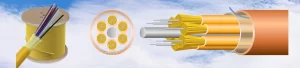
Ribbon fiber cable is specifically designed for high-density optical networks. Instead of placing each optical fiber loosely inside a buffer tube, ribbon cable arranges multiple fibers side by side in flat ribbon structures. The most common ribbon contains twelve fibers, and multiple ribbons are stacked together to create cables with extremely high fiber counts such as 144, 288, 432, 864, or even 1728 fibers.
This unique construction allows hundreds of fibers to be packaged into a relatively compact cable while maintaining excellent organization and consistency. More importantly, ribbon fibers remain precisely aligned, enabling mass fusion splicing instead of individual fiber splicing.
For large backbone projects, this difference is significant. Rather than splicing twelve fibers one at a time, technicians can splice an entire ribbon in a single operation. The result is faster installation, lower labor costs, and more consistent splice quality across large deployments.
Ribbon Fiber vs. Traditional Fiber Cable
Ribbon fiber cable and conventional loose tube cable each have their own strengths, but they are designed for different priorities.
Loose tube cables have long been the standard choice for outside plant networks, FTTx deployments, and general telecommunications infrastructure because they provide excellent environmental protection and flexibility. They perform exceptionally well in many outdoor applications where individual fiber access is more important than installation speed.
Ribbon fiber cable, however, was developed with large-scale, high-density deployments in mind. By combining hundreds of fibers within a compact cable and supporting mass fusion splicing, ribbon cable dramatically improves deployment efficiency. For backbone networks, metro systems, cloud campuses, and hyperscale data centers, these advantages become increasingly valuable as fiber counts continue to rise.
| Feature | Ribbon Fiber Cable | Loose Tube Cable |
|---|---|---|
| Fiber Density | Excellent | Good |
| Installation Speed | Very Fast | Moderate |
| Mass Fusion Splicing | Yes | No |
| Cable Diameter | Smaller at High Fiber Counts | Larger |
| Scalability | Excellent | Good |
| AI Data Centers | Highly Recommended | Suitable for Some Applications |
Rather than replacing loose tube cable entirely, ribbon fiber complements it by addressing applications where installation efficiency, space utilization, and scalability are the highest priorities.

Why 432-Fiber and Higher Count Cables Matter
As AI infrastructure continues to expand, the advantages of high fiber count cables extend well beyond simply carrying more fibers.
One of the most immediate benefits is improved cable management. A single 432-fiber ribbon cable can replace multiple smaller cables, reducing congestion in cable trays and overhead pathways. Fewer cables also simplify labeling, routing, and ongoing maintenance, resulting in a cleaner and more organized infrastructure.
High fiber count cables also reduce deployment costs over the lifetime of a project. Although the initial cable itself may represent a larger investment, installing one backbone cable is generally far more efficient than pulling, terminating, and managing numerous lower-count cables. Combined with the speed of mass fusion splicing, installation time can be significantly reduced, especially in large-scale data center construction projects.
Perhaps the greatest advantage is scalability. AI facilities rarely remain static. New GPU clusters, storage systems, and network switches are continually added as computing demands increase. Deploying a 432-fiber or 864-fiber backbone allows operators to reserve unused fibers for future expansion, avoiding disruptive and expensive cable replacements later in the network lifecycle.
The Future Is Moving Toward Even Higher Fiber Density
The evolution of AI is pushing every layer of network infrastructure toward greater density. As transmission speeds advance from 800G to 1.6T and beyond, switch port densities will continue increasing, requiring more optical fibers within the same physical space.
At the same time, hyperscale cloud providers are building larger campuses than ever before. Rather than treating fiber infrastructure as a short-term requirement, operators are designing networks capable of supporting future growth for many years. This trend is driving demand not only for 432-fiber ribbon cables but also for 864-fiber, 1728-fiber, and emerging rollable ribbon fiber technologies that provide even higher densities without significantly increasing cable diameter.
Rollable ribbon fiber represents another important development. Unlike traditional flat ribbons, rollable ribbon designs provide greater flexibility during installation while maintaining compatibility with mass fusion splicing. As cable densities continue to increase, this technology is expected to play an increasingly important role in next-generation AI data centers.
Choosing the Right Ribbon Fiber Cable
Selecting the appropriate ribbon fiber cable requires balancing current network requirements with future expansion plans. Fiber count is naturally one of the first considerations, but cable construction, fiber type, jacket material, installation environment, and splicing method are equally important.
For most AI backbone deployments, OS2 singlemode ribbon cable is the preferred choice due to its ability to support long-distance, high-bandwidth transmission with minimal signal loss. Indoor/outdoor cable constructions, LSZH jackets, and high-density ribbon designs further improve deployment flexibility while ensuring compatibility with modern data center standards.
Planning for future growth is equally important. Choosing a slightly higher fiber count today can eliminate costly infrastructure upgrades tomorrow, making high fiber count ribbon cable a long-term investment rather than simply a network component.
Conclusion
Artificial intelligence is redefining how data centers are designed, built, and expanded. As computing clusters become larger and network speeds continue to accelerate, the physical fiber infrastructure must evolve alongside them. Simply adding more conventional fiber cables is no longer sufficient to support the density, scalability, and efficiency required by modern AI environments.
Ribbon fiber cable provides a practical solution by combining high fiber density with faster installation and simplified network management. Among today’s available options, 432-fiber ribbon cable has become one of the most balanced choices, offering ample capacity for current deployments while leaving room for future expansion. Looking ahead, even higher fiber count solutions, including 864-fiber and rollable ribbon cable technologies, are expected to become increasingly common as hyperscale AI data centers continue to grow.
For organizations building next-generation network infrastructure, investing in high fiber count ribbon cable is not simply about increasing fiber capacity—it is about creating a scalable, future-ready foundation capable of supporting the continued evolution of artificial intelligence, cloud computing, and high-performance networking for years to come.


Frequently Asked Questions
1. Why are high fiber count ribbon cables preferred in AI data centers?
High fiber count ribbon cables are designed to support the massive optical connectivity required by AI workloads. Modern AI clusters contain thousands of GPUs connected through high-speed leaf-spine networks, creating enormous east-west traffic. A 432-fiber or 864-fiber ribbon cable allows hundreds of fibers to be deployed within a compact footprint, reducing cable congestion while simplifying installation and future network expansion.
2. What is the advantage of ribbon fiber over loose tube fiber cable?
The biggest advantage of ribbon fiber cable is its ability to support mass fusion splicing. Instead of splicing each fiber individually, an entire ribbon—typically containing 12 fibers—can be spliced simultaneously. This significantly reduces installation time, labor costs, and the risk of inconsistent splice quality. Ribbon fiber also provides higher fiber density, making it ideal for backbone networks and hyperscale data centers.
3. Is a 432-fiber ribbon cable suitable for future network upgrades?
Yes. A 432-fiber ribbon cable is widely considered a future-ready backbone solution. It provides sufficient fiber capacity for current 400G and 800G deployments while leaving additional fibers available for future expansion. As AI infrastructure continues to grow and network speeds move toward 1.6T Ethernet, high fiber count cables help minimize the need for costly infrastructure replacements.
4. Where are high fiber count ribbon cables commonly used?
High fiber count ribbon cables are widely deployed in AI data centers, hyperscale cloud campuses, metropolitan backbone networks, telecommunications central offices, and large enterprise data centers. They are particularly suitable for environments where high fiber density, fast deployment, and scalable network architecture are essential.
5. How does mass fusion splicing improve installation efficiency?
Mass fusion splicing allows multiple fibers within a ribbon to be spliced in a single operation rather than one fiber at a time. For example, a standard 12-fiber ribbon requires only one fusion splice instead of twelve individual splices. This greatly reduces installation time, improves consistency, and lowers labor costs for large-scale fiber optic deployments.
6. Why is fiber density becoming increasingly important in AI networks?
As AI clusters continue to scale, network switches support more ports and higher transmission rates, resulting in a rapid increase in fiber connections. Higher fiber density enables more optical fibers to be installed within limited cable trays and conduits, improving space utilization while making future expansion easier. This is one of the primary reasons why ribbon fiber technology is becoming the preferred solution for modern AI data centers.
7. What fiber counts are available for ribbon fiber cables?
Ribbon fiber cables are available in a wide range of configurations to meet different network requirements. Common fiber counts include 144, 288, 432, 576, 864, and 1728 fibers. The appropriate choice depends on the network scale, expected growth, available cable pathways, and long-term capacity planning.