Skip to content







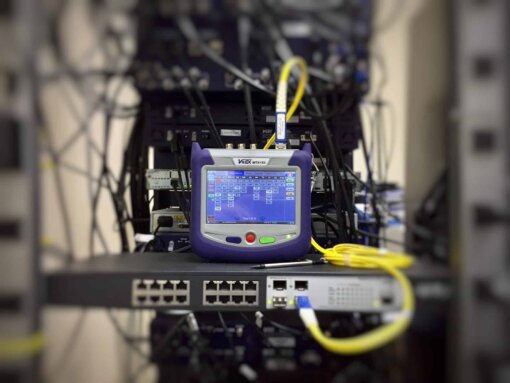



As enterprise networks continue to evolve to support cloud computing, digital collaboration, and data-driven workflows, Fast Ethernet remains a foundational networking technology. While higher-speed standards such as Gigabit and 10 Gigabit Ethernet dominate backbone and data center environments, Fast Ethernet (100 Mbps) still plays a meaningful role in access networks where cost efficiency, stability, and compatibility are priorities.
Understanding Fast Ethernet—its development, capabilities, and deployment scenarios—helps organizations design balanced networks that align performance with real-world requirements.
What Is Fast Ethernet?
Fast Ethernet is a networking technology defined by the IEEE 802.3u standard, providing data transmission speeds of up to 100 megabits per second (100 Mbps) over Ethernet-based local area networks (LANs). It was designed as a direct evolution of traditional 10 Mbps Ethernet, offering a tenfold increase in bandwidth while preserving the same Ethernet frame format and protocols.
Because Fast Ethernet maintains backward compatibility with legacy Ethernet systems, it enables straightforward upgrades without requiring complete network redesigns. This compatibility helped Fast Ethernet become a dominant LAN technology throughout enterprise, education, and industrial networks during its peak adoption period.
The Evolution of Fast Ethernet
Ethernet technology originated in the 1970s and rapidly became the global standard for wired networking. By the early 1990s, 10 Mbps Ethernet was widely deployed, but growing application complexity—such as graphical user interfaces, file sharing, and client-server computing—quickly revealed its limitations.
In response, the IEEE introduced Fast Ethernet (100 Mbps) in 1995 under the 802.3u standard. This new specification significantly increased throughput while retaining the core simplicity and reliability of Ethernet. Fast Ethernet initially gained traction in enterprise access networks and campus environments, where it provided sufficient bandwidth for office productivity applications and early multimedia workloads.
Although Gigabit Ethernet later became the mainstream access-layer standard, Fast Ethernet continues to be deployed in environments where bandwidth demands are predictable and infrastructure reuse is important.

Types of Fast Ethernet
Fast Ethernet includes multiple physical layer standards optimized for different cabling types and transmission distances:
| Fast Ethernet Type | IEEE Standard | Cable Type | Maximum Distance |
|---|---|---|---|
| 100BASE-TX | 802.3u | Cat 5 UTP | 100 m |
| 100BASE-FX | 802.3u | Multimode Fiber | 2 km |
| 100BASE-T4 | 802.3u | Cat 3 UTP | 100 m |
| 100BASE-T2 | 802.3u | Cat 3 UTP | 100 m |
Among these, 100BASE-TX became the most widely adopted due to its balance of performance, cost, and ease of installation.
Key Advantages of Fast Ethernet
Despite its lower bandwidth compared to modern standards, Fast Ethernet still offers several practical advantages:
Cost Efficiency – Ideal for budget-conscious deployments and legacy system upgrades.
Stable Performance – Proven reliability in controlled environments with predictable traffic.
Low Latency – Supports real-time communication for basic voice and control applications.
Infrastructure Compatibility – Operates on existing copper or fiber cabling, minimizing upgrade costs.
Simplicity – Easy to configure and maintain, reducing operational complexity.
These benefits make Fast Ethernet suitable for non-bandwidth-intensive applications where consistency and longevity matter more than peak speed.
Common Fast Ethernet Deployment Scenarios
Fast Ethernet continues to be used in several practical environments:
Industrial and Control Networks
Manufacturing equipment, automation systems, and monitoring devices often rely on Fast Ethernet due to its stability and deterministic performance.Legacy Enterprise Systems
Older servers, printers, access control systems, and specialized hardware may only support 100 Mbps interfaces.Education and Training Facilities
Computer labs and classrooms with predictable usage patterns can leverage Fast Ethernet for cost-effective connectivity.Embedded and Edge Devices
Many embedded systems and edge controllers require reliable, low-speed Ethernet rather than high-throughput links.
In these scenarios, Fast Ethernet serves as a dependable access-layer solution without unnecessary complexity.
Conclusion
Fast Ethernet remains an important part of the Ethernet ecosystem, providing a stable and economical networking option for legacy systems, industrial applications, and controlled environments. While higher-speed Ethernet standards continue to shape modern data centers and enterprise backbones, Fast Ethernet’s simplicity, compatibility, and reliability ensure its ongoing relevance.
By understanding where Fast Ethernet fits within today’s networking landscape, organizations can make informed infrastructure decisions that balance performance, cost, and long-term operational needs.