Skip to content





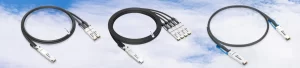






















As data centers and enterprise networks continue to scale in speed and density, selecting the right interconnect solution has become a critical design decision. Active Optical Cables (AOCs) have emerged as a preferred option for short- to mid-range high-speed links, offering a balance of performance, simplicity, and manageability.
However, not all AOC cables are the same. Choosing the right AOC requires an understanding of its fundamentals, application scenarios, form factors, and key technical parameters—as well as how it compares to alternatives such as DAC (Direct Attach Copper) cables. This guide provides a structured approach to selecting the most suitable AOC cable for your network.
What Is an AOC Cable?
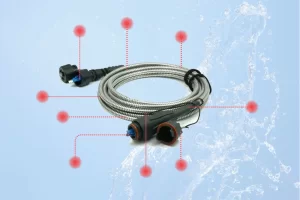
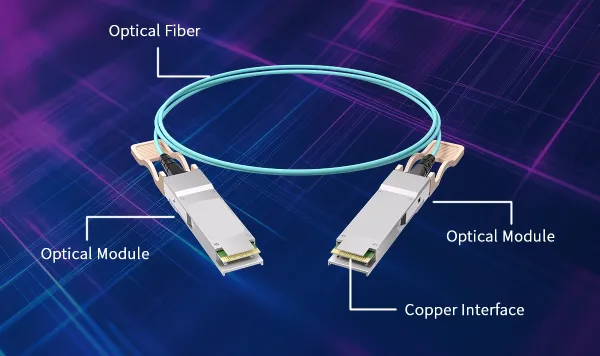
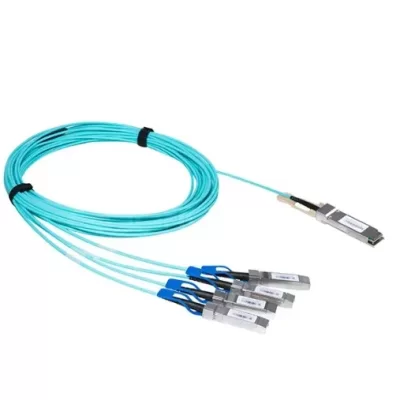
An Active Optical Cable (AOC) is an integrated interconnect solution that permanently combines optical transceivers and fiber into a single assembly. Each end of the cable contains an active module that converts electrical signals to optical signals and back again.
Compared to the traditional “transceiver + fiber patch cord” model, AOCs offer several advantages:
True plug-and-play deployment with no on-site fiber termination
Consistent factory-tested performance
Reduced installation and troubleshooting time
Lower overall cabling complexity
AOCs are widely used for 40G, 100G, and higher-speed Ethernet links within racks, between racks, and across data center rows.
Typical Application Scenarios for AOC Cables
AOC cables are optimized for short- and medium-distance connectivity where performance and cable manageability are equally important.
Common Use Cases
Intra-rack connections
Linking switches, servers, and storage devices within the same rack.Inter-rack connections
Connecting Top-of-Rack (ToR) switches to aggregation or spine switches.Data center floors and zones
Supporting high-speed links across rows or within a data hall.High-performance computing (HPC) and AI clusters
Providing low-latency, high-bandwidth connectivity with minimal EMI impact.Cloud and virtualized environments
Supporting east–west traffic between compute and storage nodes.
AOC Cable Types and Form Factors
AOCs are available in multiple form factors to support different network architectures and migration paths.
Common AOC Types
| AOC Type | Typical Speed | Primary Purpose |
|---|---|---|
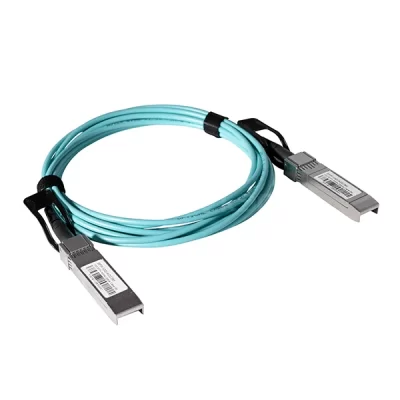
| QSFP+ to QSFP+ AOC | 40G | Switch-to-switch or server-to-switch |
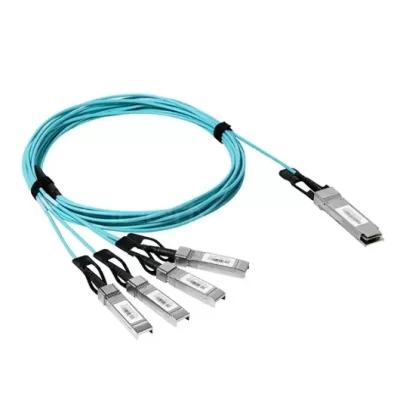
| QSFP+ to 4× SFP+ AOC | 40G to 4×10G | Port breakout and migration |
| QSFP28 to QSFP28 AOC | 100G | Spine–leaf or core links |
| QSFP28 to 4× SFP28 AOC | 100G to 4×25G | Gradual 25G/100G upgrades |
| SFP-DD to QSFP28 AOC | 100G | Cross-generation connectivity |
Breakout AOCs are especially valuable when transitioning between network speeds, enabling higher port utilization and phased upgrades.
Key Parameters to Consider When Choosing an AOC
Understanding the core technical parameters helps ensure compatibility and long-term reliability.
1. Data Rate and Modulation
Common speeds: 10G, 25G, 40G, 100G
Higher speeds may use PAM4 modulation, which increases bandwidth efficiency but requires better signal quality and FEC support.
2. Connector and Form Factor
Ensure the AOC matches the port type on both ends:
Mismatch at the form-factor level cannot be corrected without active conversion.
3. Cable Length
Typical AOC lengths range from 1 m to 100 m.
Shorter links favor lower latency and power consumption.
Longer links benefit from optical transmission stability.
4. Power Consumption
AOCs consume more power than DAC cables due to active components, but far less than discrete transceiver solutions.
5. Bend Radius and Jacket Type
Smaller bend radius improves routing in dense racks.
OFNP/LSZH jackets are recommended for indoor data center environments.
AOC vs DAC: When to Choose Each
DAC cables are often considered alongside AOCs. The choice depends on distance, density, and environmental requirements.
| Feature | AOC | DAC |
|---|---|---|
| Medium | Optical Fiber | Copper |
| Typical Distance | Up to 100 m | Usually ≤5–7 m |
| Weight & Thickness | Light, thin | Heavy, thick |
| EMI Immunity | Excellent | Limited |
| Power Consumption | Higher | Very low |
| Cost (short reach) | Higher | Lower |
How to decide:
Choose DAC for very short, cost-sensitive links within the same rack.
Choose AOC when distance increases, cabling density is high, or airflow and EMI become concerns.
In many modern data centers, DAC and AOC coexist, each optimized for specific segments of the network.
A Step-by-Step Guide to Choosing the Right AOC Cable
Identify Port Types on Both Ends
Confirm the exact interface (QSFP+, QSFP28, SFP-DD, etc.).Define Required Speed and Breakout Needs
Decide whether a direct link or breakout configuration is required.Measure Distance Accurately
Include routing paths, not just straight-line distance.Evaluate Rack Density and Airflow
High-density environments strongly favor AOCs over thick copper DACs.Check Vendor Compatibility and Coding
Ensure the AOC is tested and coded for your switch or NIC platform.Plan for Future Scalability
Choose AOC types that align with upcoming speed or architecture upgrades.
Conclusion
Selecting the right AOC cable is not just about speed—it is about balancing performance, distance, density, power consumption, and long-term scalability. AOCs offer a clean, reliable, and high-performance interconnect solution for modern networks, especially where copper DACs reach their physical limits.
By understanding AOC fundamentals, comparing them thoughtfully with DAC alternatives, and applying clear selection criteria, network designers can build interconnect infrastructures that are efficient, scalable, and easy to maintain.