Skip to content
















































The global optical fiber industry is entering a period of significant change. After years of relatively stable supply conditions and intense price competition, the market has begun to face renewed pressure from rising demand, constrained manufacturing capacity, and shifting investment priorities. The rapid expansion of AI data centers, continued telecom infrastructure upgrades, and growing demand for high-density optical connectivity are reshaping the industry’s supply-demand balance. At the same time, upstream production constraints and longer manufacturing cycles are making it increasingly difficult for suppliers to respond quickly to changing market conditions.
These developments extend well beyond the market for bare optical fiber. Changes in fiber availability and material costs are gradually influencing the entire supply chain, from optical fiber drawing and cable manufacturing to fiber optic patch cords, pre-terminated assemblies, and high-density data center connectivity solutions. For manufacturers, distributors, and infrastructure project owners, understanding these interconnected changes is becoming essential to managing costs, securing supply, and planning future deployments.
As the industry moves toward 2027, the key question is no longer simply whether optical fiber prices will continue to rise. It is how the changing demand structure, manufacturing capacity, and connectivity technologies will reshape the global fiber optic market in the years ahead.
1. The Global Optical Fiber Market: What Changed in 2026?
The optical fiber market experienced a notable shift in supply-demand conditions during 2025 and 2026. Following an extended period of price competition and relatively abundant supply, demand began to recover across several major application segments. This recovery was initially supported by traditional telecommunications investment, but the rapid expansion of AI infrastructure introduced an additional source of demand that has placed greater pressure on selected fiber categories and manufacturing resources.
The impact has not been uniform across all fiber types. Standard single-mode fiber, particularly G.652D, continues to serve as the foundation of telecommunications networks, including long-haul transmission, metropolitan networks, and access infrastructure. Its demand is therefore closely connected to telecom capital expenditure and national broadband programs. Bend-insensitive fibers such as G.657A1 and G.657A2 serve a broader range of applications, including FTTH drop cables, compact indoor installations, and high-density fiber routing. Their ability to maintain optical performance under tighter bending conditions makes them particularly relevant as installation environments become more space-constrained. Meanwhile, multimode fibers such as OM3, OM4, and OM5 remain important in short-reach data center applications, although their future demand will depend partly on the evolution of network architectures and optical transceiver technologies.
The changing demand structure is also affecting procurement conditions. Buyers may encounter shorter quotation validity periods, less predictable delivery schedules, and greater differences between spot-market prices and long-term contract pricing. These changes are particularly noticeable in products that depend on specialized materials, limited production capacity, or customized manufacturing processes. However, it is important to distinguish between the market for bare fiber and that for finished fiber optic products. A rise in bare-fiber prices does not automatically translate into an equivalent increase in the price of every cable or connectivity assembly, since each product has a different material composition and manufacturing cost structure.
Regional market conditions also deserve attention. North America is seeing strong investment in hyperscale data centers and domestic communications infrastructure, while Europe continues to balance broadband expansion, network modernization, energy costs, and regulatory requirements. In other growth markets, national infrastructure programs, local manufacturing policies, import tariffs, and currency fluctuations can produce different pricing and supply conditions. As a result, global market averages may not accurately reflect the actual procurement environment in a particular country or for a specific product specification.
2. AI Data Centers Are Reshaping Optical Fiber Demand
Among the various forces influencing the optical fiber market, AI data center development represents one of the most important structural changes. Unlike conventional enterprise or cloud data centers, large-scale AI facilities are designed around clusters of high-performance GPUs and specialized computing systems that require extremely high bandwidth and low-latency communication. These systems depend on extensive optical interconnections between servers, switches, racks, and separate buildings, creating new requirements for fiber capacity, connection density, and installation efficiency.
The growing scale of AI infrastructure is changing how optical fiber is deployed inside data centers. Connections between equipment within racks and between adjacent racks may use short-reach optical links, while connections across larger data center spaces and campus environments increasingly rely on high-capacity single-mode fiber infrastructure. As network speeds progress from 400G to 800G and toward 1.6T, operators must also reconsider the physical connectivity architecture supporting these systems. The result is not simply an increase in the number of optical links, but a greater emphasis on compact connectors, higher fiber counts, improved cable management, and more efficient deployment methods.
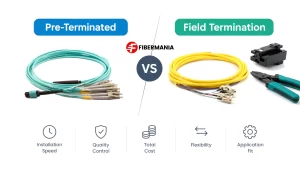
This shift is particularly relevant to high-density connectivity solutions. MPO/MTP trunk cables and harness assemblies allow multiple optical channels to be connected through a compact interface, reducing the number of individual connections required during installation. As data center networks become more complex, factory-terminated assemblies can also help improve installation consistency and reduce the time required for on-site termination and testing. These advantages become increasingly valuable in large projects where deployment schedules are closely tied to equipment installation and network commissioning.
Smaller connector formats are also gaining attention as operators look for ways to increase port density without expanding equipment footprints. MDC and MMC connectors are examples of this development. Their compact designs support higher-density connectivity environments and provide additional flexibility for applications where space is limited. Although different connector formats serve different optical architectures and compatibility requirements, the broader direction is clear: future data center connectivity will place increasing importance on smaller interfaces, higher fiber counts, and more efficient cable management.
The demand for optical connectivity is therefore evolving alongside the development of AI computing infrastructure. Fiber optic components are no longer just passive cabling elements within a data center. They are becoming an increasingly important part of the physical architecture that determines how efficiently large computing systems communicate. This creates opportunities not only for bare-fiber producers, but also for manufacturers specializing in high-density patch cords, trunk cables, harness assemblies, and customized connectivity solutions.
3. Where Are the Bottlenecks in the Optical Fiber Supply Chain?
The pressure on the optical fiber market cannot be explained by demand growth alone. A major part of the challenge comes from the time and investment required to expand manufacturing capacity throughout the supply chain. Optical fiber production is a highly specialized process that begins with the preparation of high-purity glass preforms, followed by fiber drawing, coating, testing, and subsequent cable manufacturing. Each stage requires specific equipment, process expertise, and quality controls, meaning that additional demand cannot always be converted into finished products immediately.
At the upstream level, preform production remains one of the most technically demanding stages. The quality and consistency of the preform directly influence the optical and mechanical characteristics of the resulting fiber. Expanding preform capacity requires substantial capital investment, advanced process control, and a lengthy period of equipment installation and qualification. Even when manufacturers announce new production projects, the additional capacity may take considerable time to reach stable commercial output. This limits the industry’s ability to respond rapidly when demand increases across several fiber categories at the same time.
Fiber drawing introduces another set of constraints. During this process, a preform is heated and drawn into a continuous glass fiber with a precisely controlled diameter, after which protective coatings are applied. Drawing towers, coating systems, and associated inspection equipment must operate within tightly controlled production conditions to maintain consistent optical performance. High utilization rates, equipment availability, production yields, and the qualification requirements of individual fiber grades can all affect effective output. Furthermore, manufacturers cannot always transfer production resources between different fiber types without considering differences in process parameters, coating requirements, and customer specifications.
Specialty materials add another layer of complexity. Different fiber applications require coatings and protective materials with specific mechanical and optical characteristics. Bend-insensitive fibers, for example, must maintain acceptable transmission performance under tighter bending conditions, while other specialty fibers may require more demanding mechanical or environmental properties. Downstream cable manufacturers also depend on materials such as PBT, aramid yarn, LSZH compounds, and steel armor. Changes in the availability or cost of these materials can influence production schedules and finished-product pricing, even when the supply of bare fiber remains relatively stable.
The pressure becomes more complicated as products move into downstream manufacturing. Producing a fiber optic cable or connectivity assembly involves additional processes such as cable construction, connector assembly, polishing, bonding, optical testing, and final inspection. High-density MPO/MTP assemblies, for example, require precise fiber arrangement, polarity control, connector processing, and inspection across multiple optical channels. These requirements mean that additional bare-fiber availability alone does not guarantee an equivalent increase in finished connectivity production.
This distinction is important when evaluating the industry’s supply constraints. The optical fiber supply chain is not a single production process with one universal bottleneck. It is a connected manufacturing system in which limited capacity, material availability, technical qualification, and production efficiency at different stages can influence the final delivery of a product.

4. Which Fiber Optic Products Will See the Greatest Demand Growth?
The changing structure of optical fiber demand is creating different opportunities across product categories. While traditional fiber patch cords and telecommunications cables will continue to serve a broad range of applications, several specialized connectivity products are becoming increasingly important as data center architectures evolve and outdoor network infrastructure expands.
MPO/MTP trunk cables are among the products most closely associated with the growth of high-density data center connectivity. Their multi-fiber interfaces allow large numbers of optical channels to be deployed through relatively compact cable assemblies, making them suitable for structured cabling systems and high-density network environments. As data centers adopt faster optical interconnects and more complex switching architectures, the need for organized, scalable fiber distribution is likely to remain strong. Pre-terminated trunk cables and harness assemblies also support faster deployment by reducing the amount of field termination required, which can help improve installation efficiency and consistency across large projects.
The development of MDC and MMC connectors reflects another important direction in optical connectivity: miniaturization. As equipment manufacturers seek to increase port density and make more efficient use of available space, smaller connector footprints become increasingly attractive. These formats can support compact optical interfaces and high-density patching environments, although their adoption will depend on equipment compatibility, network architecture, and the availability of qualified components. For connectivity manufacturers, this trend creates a need for greater precision in assembly processes and a wider range of customized cable configurations.
Standard fiber optic patch cords will remain essential despite the growing attention given to advanced data center solutions. LC, SC, and other established connector formats continue to support telecommunications networks, enterprise infrastructure, testing environments, and a wide range of optical equipment. Their demand is supported by the large installed base of existing networks, ongoing maintenance requirements, and continuous infrastructure expansion. Rather than being replaced by newer connector technologies, conventional patch cords will continue to coexist with higher-density solutions, serving applications where compatibility, cost efficiency, and ease of maintenance remain priorities.
Outdoor connectivity products represent another important segment. FTTA systems, remote radio installations, and distributed antenna networks require fiber assemblies that can withstand environmental exposure, mechanical stress, and repeated installation or maintenance operations. Waterproof connectors, ruggedized cables, and customized outdoor assemblies are therefore important components of modern telecommunications infrastructure. Although the pace of FTTA deployment varies by region and operator investment cycle, the need for reliable outdoor optical connectivity will continue to support demand for specialized cable assemblies.
Taken together, these product categories illustrate how the market is moving toward a more diversified connectivity ecosystem. Traditional patch cords, high-density data center assemblies, miniaturized connectors, and outdoor fiber solutions serve different technical requirements, but all depend on reliable manufacturing, consistent material quality, and the ability to meet increasingly specific application demands.
5. What Does the Market Mean for Fiber Optic Buyers?
For buyers and project owners, the changing optical fiber market creates challenges that extend beyond the price of individual components. Procurement decisions increasingly need to account for material availability, manufacturing lead times, product qualification, and the reliability of the supplier’s production system. In a stable market, buyers may focus primarily on unit pricing and technical specifications. Under more volatile supply conditions, however, the ability to secure the required products within a defined project schedule can become equally important.
One of the first issues is quotation volatility. When upstream material costs change frequently, manufacturers may shorten quotation validity periods or introduce pricing adjustments for orders scheduled far into the future. Buyers should therefore pay attention to the effective date of a quotation, its validity period, the confirmed production schedule, and whether material costs are fixed or subject to adjustment. Comparing quotations also requires a like-for-like approach. Differences in fiber grade, cable construction, connector quality, polishing requirements, testing standards, and packaging can produce significant price variations between products that appear similar at first glance.
Lead-time management is equally important. Customized fiber optic assemblies often require additional engineering review, material preparation, production scheduling, and testing before shipment. Products with unusual fiber counts, specialized cable constructions, or non-standard connector configurations may be more difficult to source quickly than standard products. For large data center or telecommunications projects, buyers should define their expected quantities and technical requirements as early as possible, allowing manufacturers sufficient time to review specifications, secure materials, and arrange production capacity.
Supplier qualification should also receive greater attention. A competitive quotation is useful only when the supplier can consistently deliver products that meet the required technical and quality standards. Buyers should evaluate manufacturing experience, quality management procedures, optical testing capabilities, production capacity, and the supplier’s ability to manage customized orders. For high-density MPO/MTP assemblies, for example, quality assurance involves more than checking insertion loss. Polarity, fiber mapping, end-face quality, mechanical integrity, and consistency across multiple channels are also important considerations.
Another practical consideration is the balance between standardization and customization. Customized products are often necessary to meet specific installation requirements, but excessive specification variations can increase procurement complexity and create additional production dependencies. Where application requirements permit, using standardized cable constructions, connector interfaces, and established product configurations can simplify sourcing and improve manufacturing efficiency. At the same time, manufacturers with flexible OEM and ODM capabilities remain valuable when projects require specialized lengths, fiber counts, connector combinations, or environmental protection features.
For buyers managing long-term infrastructure projects, procurement planning should increasingly be integrated into the engineering process. Rather than treating fiber optic components as materials that can be purchased immediately before installation, project teams should identify critical connectivity products during the design stage. This approach allows more time for supplier qualification, sample approval, production planning, and delivery coordination. In a market where manufacturing capacity and material availability can change quickly, early planning provides a practical way to reduce project risk.

6. Optical Fiber Market Outlook: What to Expect in 2027?
The outlook for the global optical fiber market in 2027 will depend on the interaction between new manufacturing capacity, continued infrastructure investment, and the industry’s ability to adapt to changing demand. Several major manufacturers have announced investments in optical fiber and connectivity production, particularly in North America, where data center development and domestic infrastructure requirements are supporting additional capacity. However, the announcement of an expansion does not immediately translate into available market supply. Equipment installation, process stabilization, production qualification, and customer approval all take time, meaning that the actual impact of new capacity may emerge gradually rather than all at once.
If these expansion projects progress as planned, the supply-demand balance for mainstream optical fiber products could become more stable as additional production capacity enters commercial operation. This may reduce some of the pressure on standard single-mode fiber and commonly used cable products. Nevertheless, the timing and scale of any improvement will vary by manufacturer, region, and product specification. Specialty grades and highly customized products may continue to experience longer qualification cycles and more limited production availability, even when overall industry capacity begins to improve.
On the demand side, AI infrastructure is likely to remain an important source of investment. The development of larger GPU clusters, higher-speed Ethernet networks, and next-generation optical interconnects will continue to create demand for fiber-rich data center architectures. The transition toward 800G and 1.6T connectivity will also influence the selection of optical transceivers, fiber types, connector formats, and pre-terminated cabling systems. However, the relationship between network speed and fiber consumption is not necessarily linear. Advances in optical technology, higher-density cabling, and improvements in network architecture may allow operators to transmit more data without increasing fiber usage at the same rate.
Traditional telecommunications investment will remain another important part of the market. FTTH expansion, 5G infrastructure, network modernization, and the maintenance of existing fiber networks will continue to support baseline demand. Regional differences in public infrastructure funding, operator investment priorities, and regulatory conditions will influence how strongly these projects contribute to overall consumption. As a result, the market may experience different recovery patterns across North America, Europe, and other growth regions.
A useful way to assess the 2027 outlook is to consider several possible developments. If new production capacity enters the market faster than demand expands, pricing pressure could gradually ease, particularly for mainstream fiber grades and standardized products. If AI data center investment continues to accelerate while capacity additions are delayed, supply conditions may remain tight for longer. A more moderate scenario would involve continued demand growth accompanied by gradual manufacturing expansion, resulting in a market that remains relatively firm but becomes less volatile over time.
For downstream connectivity manufacturers and buyers, the most important implication is that market normalization may not occur simultaneously across all product categories. Bare fiber, standard optical cables, high-density patch cords, and specialized connectivity assemblies have different production requirements and supply dependencies. The products with the most complex specifications or limited qualified manufacturing capacity may continue to require longer planning horizons even after the broader market becomes more balanced.
Conclusion
The global optical fiber industry is undergoing more than a temporary adjustment in material prices. The expansion of AI data centers, continued investment in telecommunications infrastructure, and increasing demand for high-density optical connectivity are changing the structure of the market. At the same time, constraints in preform production, fiber drawing, specialty materials, and downstream manufacturing are limiting how quickly the supply chain can respond to these developments.
For the industry as a whole, this means that manufacturing capacity and supply chain reliability are becoming increasingly important alongside product performance and cost competitiveness. The impact is also extending beyond bare optical fiber to finished cables, patch cords, MPO/MTP assemblies, and other connectivity products. As network architectures become more demanding, manufacturers must be able to combine material control, precise production processes, consistent quality management, and flexible customization.
For buyers, the changing market reinforces the importance of looking beyond unit price when evaluating suppliers and planning projects. Early procurement planning, clear technical specifications, reliable supplier relationships, and realistic delivery schedules can help reduce exposure to supply disruptions. For manufacturers, investment in production efficiency, quality control, and advanced connectivity capabilities will be essential to meeting the requirements of an increasingly complex market.
Looking toward 2027, the optical fiber market will continue to be shaped by the balance between expanding infrastructure demand and the pace of new manufacturing capacity. Even if supply conditions gradually improve, the industry’s longer-term direction is becoming increasingly clear: higher data transmission requirements, denser optical networks, and more sophisticated connectivity solutions will continue to influence how fiber optic products are designed, manufactured, and deployed.
Frequently Asked Questions (FAQ)
1. Why is the global optical fiber market experiencing supply pressure?
The market is facing pressure from several overlapping sources of demand, including AI data center construction, telecommunications network upgrades, and continued FTTH deployment. At the same time, expanding upstream production capacity requires substantial investment, specialized equipment, and lengthy qualification processes. These factors make it difficult for manufacturers to increase output quickly when demand rises across multiple product categories.
2. Which optical fiber types are most affected by changing market demand?
Different fiber types are influenced by different application requirements. G.652D remains important for traditional telecommunications networks, while G.657A1 and G.657A2 support bend-insensitive applications such as FTTH and high-density installations. OM3, OM4, and OM5 multimode fibers are used in short-reach data center connections. The actual supply and pricing conditions for each grade depend on production capacity, regional demand, and the availability of qualified materials.
3. How is AI driving demand for fiber optic connectivity?
AI data centers require extensive optical interconnections to support communication between GPUs, servers, switches, and separate computing facilities. Higher network speeds and denser equipment configurations increase the importance of high-fiber-count cables, MPO/MTP assemblies, compact connectors, and pre-terminated connectivity solutions. These products help support the bandwidth, density, and deployment efficiency required by modern AI infrastructure.
4. Will optical fiber prices decrease in 2027?
Prices may become more stable as new manufacturing capacity enters commercial production, but the timing will depend on how quickly expansion projects are completed and qualified. Continued AI infrastructure investment and telecommunications demand could also maintain pressure on selected fiber categories. Mainstream products and specialized connectivity components may therefore follow different pricing and supply trends.
5. How can fiber optic buyers manage longer lead times and supply uncertainty?
Buyers can reduce procurement risks by defining technical requirements early, qualifying suppliers before major orders, and planning material purchases according to project schedules. Comparing quotations on an equivalent specification basis, confirming production capacity, and maintaining communication with manufacturers are also important. For customized products and large-volume projects, early coordination with suppliers can help secure materials and production slots more effectively.