Skip to content

































The digital revolution has fundamentally transformed how we store, process, and transmit information. At the heart of this transformation lies the modern data center—a facility that has evolved from simple server rooms into sophisticated ecosystems powering everything from cloud services to artificial intelligence. As we stand at the intersection of exponential technological growth and unprecedented computational demands, understanding the trajectory of data center development has never been more critical.
Understanding Data Centers: The Backbone of the Digital Age
A data center is a specialized facility designed to house computer systems, servers, networking equipment, and data storage devices that support the computational and storage needs of organizations and digital services. These facilities serve as the physical infrastructure behind virtually every digital experience—from streaming video content and social media platforms to enterprise applications and scientific computing.
Modern data centers operate as complex ecosystems where power, cooling, networking, and security systems work in harmony to ensure continuous operation. They range in scale from small enterprise facilities occupying a single room to hyperscale installations spanning hundreds of thousands of square feet with millions of servers. As of 2024, the United States alone hosts over 2,500 data centers, with concentrations in key markets like Northern Virginia, Dallas, and the Bay Area.
The fundamental architecture of a data center relies heavily on high-performance connectivity infrastructure. This is where fiber optic technology becomes indispensable—serving as the nervous system that enables rapid data transmission with minimal latency and signal loss.
The Evolution: From Server Rooms to Hyperscale Giants
The journey of data center development reflects broader technological shifts over the past several decades. In the early days of corporate computing, organizations maintained modest server rooms with basic cooling and power infrastructure. These facilities primarily supported internal business operations with relatively modest bandwidth and processing requirements.
The advent of the internet in the 1990s catalyzed the first major transformation. As businesses established online presence and e-commerce platforms emerged, the demand for reliable, scalable data center infrastructure grew dramatically. This period saw the birth of colocation services, where multiple organizations could share facility resources, and the emergence of dedicated data center providers.
The 2000s brought cloud computing, which fundamentally restructured the industry. Companies like Amazon, Google, and Microsoft built massive hyperscale facilities designed for efficiency at unprecedented scales. These centers introduced innovations in power distribution, cooling systems, and network architecture that would become industry standards. Power densities that were once 5-10 kilowatts per rack gradually increased to 40 kilowatts as computing became more concentrated.
Throughout this evolution, fiber optic connectivity advanced in parallel. Early data centers relied on copper cabling, but the bandwidth limitations and signal degradation over distance made fiber optics the inevitable choice for high-performance applications. By the 2010s, multimode and single-mode fiber had become standard for data center interconnects, backbone networks, and campus connections.
The AI Revolution: A Paradigm Shift in Data Center Requirements
The emergence of generative AI and large language models has fundamentally altered data center dynamics in ways that dwarf previous technological transitions. The launch of ChatGPT and similar technologies in late 2022 triggered an infrastructure arms race that continues to reshape the industry.
Unprecedented Power and Density Demands
AI workloads, particularly those involving training large neural networks, require dramatically different infrastructure than traditional cloud applications. Current AI training operations demand approximately 30 megawatts of continuous power, while rack power densities have surged from 40 kilowatts to 130 kilowatts, with projections reaching 250 kilowatts. This represents a five-fold increase in density compared to traditional data center racks.
By 2025, nearly 75% of new data centers are being designed specifically with AI workloads in mind, fundamentally shifting industry priorities. This isn’t merely about adding more servers—it requires complete rearchitecting of facility systems including power distribution, cooling infrastructure, and network topology.

The Fiber Optic Imperative in AI Infrastructure
The AI revolution has dramatically intensified demand for fiber optic connectivity. AI-focused data centers require approximately 36 times more fiber than traditional CPU-based racks to handle massive data volumes and high-speed connectivity required by GPU clusters. This exponential increase stems from the need to interconnect hundreds or thousands of GPUs that must exchange vast amounts of data during model training.
Advanced GPU configurations like Blackwell nodes require 16 times more fiber than traditional cloud switch racks. These systems demand not just more fiber strands, but higher-performance specifications including 400 Gbps to 800 Gbps links that are becoming standard, with cutting-edge deployments reaching 1.6 Tbps.
For companies like FiberMania specializing in fiber optic jumpers and patch cords, this represents a tremendous opportunity. The market requires high-density cabling solutions that can pack hundreds of fiber strands into compact form factors while maintaining performance specifications. Pre-connectorized solutions that reduce installation time and complexity have become particularly valuable as data center operators race to bring capacity online.
Cooling Infrastructure Transformation
Traditional air cooling systems have become obsolete for high-density AI racks. The industry has rapidly adopted liquid cooling technologies, including direct-to-chip cooling and rear-door heat exchangers, to manage the thermal output of dense GPU clusters. This shift impacts fiber infrastructure as well, requiring cables and connectors that can operate reliably in higher-temperature and higher-humidity environments.
Geographic and Power Considerations
The United States hosts 51% of the world’s hyperscale AI facilities, with Northern Virginia remaining the largest concentration. However, power constraints in traditional markets are driving expansion to secondary locations like Columbus, Ohio, and San Antonio, Texas, where electrical capacity remains available.
The power challenge is substantial. Global demand for data center capacity could rise at an annual rate of between 19 and 22 percent from 2023 to 2030, potentially reaching 171 to 219 gigawatts annually, compared to current demand of 60 gigawatts. Meeting this demand will require building at least twice the data center capacity constructed since 2000—but in less than a quarter of the time.

The Robotics Revolution: Automating Data Center Operations
While AI’s computational demands capture most attention, another technological advancement is quietly transforming how data centers operate: robotics. The integration of robots—including increasingly sophisticated humanoid robots—into data center environments represents a fundamental shift in facility management, maintenance, and operations.
From Concept to Reality: Robots in Action
The concept of automated, “lights-out” data centers has existed for years, but recent advances in robotics, AI, and machine learning have accelerated practical deployment. According to Gartner’s projections, half of cloud data centers will leverage advanced robots with AI and machine learning capabilities by 2025, potentially increasing operating efficiency by 30 percent.
Leading operators have already implemented robotics across diverse applications. Google employs robots for hard drive destruction, creating fully automated disk disposal environments that enhance security while reducing labor requirements. Alibaba’s second-generation Tianxun robot operates autonomously across five data centers, automatically identifying and replacing faulty hard disks without human intervention. Digital Edge has deployed robots for visitor authentication, security patrols, and facility maintenance, including aerial drones that use AI visualization tools to inspect rooftops and identify maintenance needs following severe weather events.
The Case for Humanoid Robots
Traditional industrial robots—resembling mechanical arms more than the sci-fi androids of popular imagination—excel at specific, repetitive tasks in controlled environments. However, humanoid robots offer distinct advantages for data center applications. Because data centers are designed for human access and operation, humanoid robots can navigate existing infrastructure without facility modifications. They can open doors, operate elevators, climb stairs, and access equipment at various heights—capabilities that stationary or wheeled robots lack.
Companies like Boston Dynamics are developing humanoid robots capable of lifting servers into cabinets, carrying payloads, and performing physical tasks that previously required human technicians. These capabilities become particularly valuable as rack densities increase and equipment becomes heavier. A humanoid robot can safely handle servers weighing 80-100 pounds repeatedly without fatigue, reducing workplace injury risks.
Practical Applications Transforming Operations
The most immediate robotics applications address repetitive, time-consuming tasks that consume significant staff resources. Physical monitoring represents a prime example—robots equipped with thermal sensors, cameras, and environmental monitors can conduct continuous facility rounds, gathering temperature data at individual rack level, detecting unusual sounds from cooling systems, and identifying potential issues before they escalate.
Security applications have gained substantial traction. Autonomous robots patrol facilities continuously, using facial recognition, motion detection, and thermal imaging to identify potential threats. These systems augment rather than replace human security personnel, providing 24/7 coverage while alerting staff to situations requiring human judgment. The Switch Sentry, developed by Switch data centers, exemplifies this approach—a mobile robot with 360-degree cameras and sensors that operates autonomously but allows remote human takeover when incidents occur.
Server maintenance and replacement operations increasingly benefit from robotic assistance. TMGcore demonstrated robotic systems that can swap servers housed within immersion cooling tanks—an environment particularly challenging for human workers. DE-CIX became the first internet exchange to use patch robots for independently migrating customer connections during data center transitions, accomplishing what CEO Harald Summa described as “open-heart surgery” during live operations.
The COVID-19 pandemic accelerated adoption significantly. As facilities reduced on-site personnel and limited visitor access, robots enabled continued operations. NVIDIA deployed telepresence robots equipped with its own Jetson GPUs to manage supercomputer installations remotely. Engineers thousands of miles away could “walk” through facilities, inspect equipment, and coordinate work without physical presence—a capability that remains valuable beyond pandemic conditions.
Impact on Fiber Infrastructure Requirements
Robotics deployment creates specific implications for fiber optic connectivity. Robots equipped with high-definition cameras, sensors, and real-time monitoring capabilities generate substantial data streams that must be transmitted reliably. A single security robot conducting facility patrols might capture 4K video, thermal imaging, and multiple sensor feeds simultaneously—data that requires high-bandwidth, low-latency connections for effective remote monitoring and control.
Advanced telepresence robots that enable remote facility management depend on robust fiber connectivity between data centers and remote operations centers. These systems require not just bandwidth but consistent, reliable performance—network interruptions directly compromise operational continuity. For companies like FiberMania, this creates opportunities for specialized fiber solutions supporting robotic platforms, including ruggedized cables suitable for mobile robot deployment and high-performance fixed connections for robot charging and data synchronization stations.
The Human-Robot Workforce Partnership
Contrary to fears about job displacement, robotics implementation is restructuring rather than eliminating data center workforces. While robots handle repetitive tasks like environmental monitoring, server scanning, and routine patrols, human workers increasingly focus on higher-value activities requiring analytical thinking, problem-solving, and decision-making.
Each robot requires human programmers, operators, and maintenance technicians. As one robot takes over routine monitoring, it creates new roles for staff who analyze the data that robot collects, identify patterns in equipment behavior, and make strategic decisions about maintenance scheduling and capacity planning. Industry experts emphasize that robots excel at precise, repetitive work performed under controlled conditions, while humans provide the intuition, adaptability, and creative problem-solving essential for unexpected situations.
This partnership proves particularly valuable as data centers scale. The gap between available technical staff and the number of servers requiring oversight continues widening. By 2030, an estimated 90 percent of businesses globally plan to implement robotic automation in some form—a dramatic increase from just 20 percent in 2021. For data centers struggling to recruit sufficient skilled personnel, robotics offers a path to maintain and improve service reliability despite workforce constraints.
Future Directions in Data Center Robotics
Several emerging trends will shape robotics evolution in data center environments. Humanoid robots will become more capable and affordable, transitioning from specialized applications to routine deployment. As these platforms mature, their ability to perform diverse tasks—from equipment installation to emergency response—will increase their value proposition.
AI integration will advance significantly. Current robots follow programmed routines, but future systems will employ machine learning to optimize patrol routes based on historical issue patterns, predict equipment failures from subtle operational changes, and coordinate multiple robots for complex tasks. The combination of AI-powered data analysis with physical robotic capability creates powerful synergies for facility optimization.
Collaborative robots designed explicitly for human-robot teams will become standard. Rather than operating in isolated environments, these systems will work alongside human technicians, handling physical tasks while humans provide oversight and decision-making. This collaboration enables more efficient workflows than either humans or robots could achieve independently.

Future Trends and Directions
Edge Computing and Distributed AI
While hyperscale facilities capture headlines, edge computing represents an equally important trend. Edge data centers bring computational resources closer to end users and data sources, reducing latency for time-sensitive applications. AI inference—the process of using trained models to make predictions or decisions—is increasingly deployed at the edge rather than centralized facilities.
This distribution creates new requirements for fiber connectivity. Edge facilities need robust, reliable connections back to core data centers for model updates and data synchronization, while also requiring high-performance local networks. The market opportunity extends beyond hyperscale deployments to thousands of smaller facilities requiring quality fiber infrastructure.
Sustainability and Energy Innovation
Energy consumption and environmental impact have become central concerns. AI data centers face criticism as electricity consumption is expected to double from 536 terawatt-hours in 2025 to 1,072 terawatt-hours by 2030. This has prompted exploration of alternative power sources including small modular nuclear reactors, hydrogen fuel cells, and increased renewable energy integration.
Data center operators are also pursuing efficiency gains through more effective cooling systems, optimized chip design, and improved power distribution. These sustainability initiatives don’t diminish the need for connectivity infrastructure—rather, they emphasize the importance of efficient, high-performance solutions that maximize data throughput per watt consumed.
Advanced Fiber Technologies
The fiber optic industry continues to innovate to meet evolving demands. Quantum Corridor recently achieved data transfer speeds of 40 terabits per second on its fiber network—more than 1,000 times faster than conventional networks. While such capabilities may seem excessive for current applications, they represent the foundation for future quantum computing and advanced AI systems.
Hollow-core fiber technology represents another frontier, offering lower latency and higher bandwidth potential than conventional solid-core designs. As this technology matures and costs decline, it will enable ultra-low latency distributed AI clusters and more robust disaster recovery architectures.
High-density cable designs continue advancing as well. Modern intermittently bonded ribbon cables can pack 1,728 fibers into conduits that previously accommodated just 864 fibers. For operators facing conduit congestion in existing facilities, these solutions enable capacity expansion without costly infrastructure replacement.
Interconnection Complexity
Modern data centers increasingly rely on sophisticated network topologies that interconnect multiple facilities. Data center interconnect speeds have evolved from 10-100 Gbps to routinely exceeding 400 Gbps, with advanced implementations reaching terabit speeds. This enables workload distribution across geographically separated facilities and supports hybrid cloud architectures.
These complex interconnection requirements drive demand for reliable, high-performance fiber jumpers and patch cords that maintain signal integrity across diverse environmental conditions. Quality manufacturing and rigorous testing become critical differentiators as network speeds increase and tolerance for errors decreases.
AI Software Revolution
Beyond physical infrastructure, AI is transforming how data centers are managed and operated. Large language models are driving software innovations that outpace hardware advancements, with AI-powered tools automating coding processes and making custom applications more accessible. This software layer optimization will help maximize the value extracted from physical infrastructure investments.
Strategic Implications for the Fiber Optic Industry
The convergence of AI growth, sustainability imperatives, and infrastructure constraints creates a favorable environment for companies specializing in fiber optic solutions. Several key opportunities emerge:
High-Density Solutions: As existing facilities face capacity constraints, demand for high-fiber-count cables that maximize conduit utilization will remain strong. Solutions that double or triple fiber density without requiring new pathway construction offer compelling value propositions.
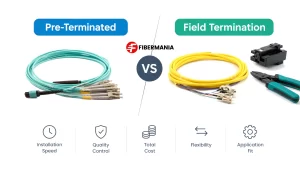
Pre-Connectorized Systems: Labor shortages have created greater need for streamlined pre-connectorized solutions that reduce installation time and minimize field termination errors. Manufacturing capabilities that deliver factory-terminated, tested assemblies will command premium positioning.
Performance Specifications: The transition to 400 Gbps, 800 Gbps, and beyond demands fiber infrastructure that meets increasingly stringent specifications for insertion loss, return loss, and polarity management. Quality control and testing capabilities become competitive advantages.
Edge Market Expansion: While hyperscale deployments represent significant volume opportunities, the proliferation of edge facilities creates sustained demand across diverse geographies and facility types. Flexible product portfolios that serve both segments will capture broader market share.
Sustainability Alignment: As operators pursue efficiency and environmental goals, fiber solutions that support these objectives—through lower power consumption, reduced material usage, or improved thermal management—will gain preferential positioning.
Conclusion: Navigating the Infrastructure Revolution
The data center industry stands at an inflection point driven by artificial intelligence’s insatiable computational demands. The infrastructure requirements for AI workloads represent not incremental changes but fundamental transformations in power density, cooling systems, and network architecture. This year saw the rise of AI factories and pioneering projects demonstrating that the rapid shift in priorities is reshaping facility design and operation.
For the fiber optic industry, this transformation creates unprecedented opportunity. The 36-fold increase in fiber requirements for AI infrastructure, combined with the ongoing buildout of edge computing capabilities and the need to interconnect facilities at terabit speeds, ensures robust demand extending years into the future.
Companies that can deliver high-density, high-performance solutions while maintaining quality and reliability will be well-positioned to participate in this growth. As FiberMania and others in the fiber optic manufacturing sector look ahead, the message is clear: the future of data centers is fiber-enabled, and that future is being built today.
The convergence of artificial intelligence, cloud computing, edge deployment, and sustainability imperatives has created a perfect storm of demand for advanced fiber infrastructure. Organizations that recognize this moment and position themselves to serve these evolving needs will help build the foundational infrastructure that powers the next generation of digital innovation.