Skip to content
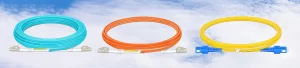
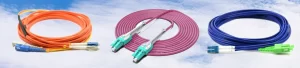
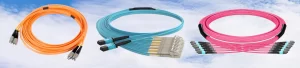
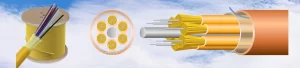








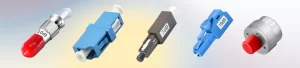






















In modern optical communication systems, fiber optic connectors serve as the physical interface that links network components together. While often overlooked, these small devices play a decisive role in ensuring signal integrity, network reliability, and long-term maintainability.
Different connector types are designed with distinct internal structures and mechanical mechanisms, each tailored for specific environments—from high-density data centers to rugged industrial applications. Understanding how these connectors are built is essential for making the right choices in network design, installation, and maintenance.
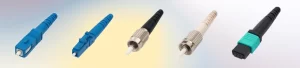
This article explores the structure and components of the most widely used fiber optic connectors, including LC, SC, ST, FC, MPO/MTP, E2000, MU, and MTRJ, and explains how their design influences performance and application.
Core Structure of Fiber Optic Connectors
Although connector designs vary, most share several fundamental components that work together to ensure precise optical alignment and mechanical stability.
| Component | Function |
|---|---|
| Ferrule | Holds and aligns the fiber core; typically ceramic for precision |
| Connector Body | Provides housing and structural support |
| Spring Mechanism | Maintains consistent الضغط between mating ferrules |
| Boot | Offers strain relief and protects the cable entry point |
| Crimp Sleeve | Secures the fiber cable within the connector |
| Coupling Mechanism | Enables connection (push-pull, threaded, or bayonet) |
The differences between connector types lie in how these elements are engineered and assembled.
LC Connector: Compact Design for High-Density Networks
The LC connector is one of the most widely used connectors today, especially in data centers. It features a 1.25 mm ceramic ferrule and a push-pull latch mechanism.
Its compact size allows twice the port density compared to larger connectors, making it ideal for environments where space is limited. The internal spring-loaded ferrule ensures consistent between fiber end faces, reducing insertion loss.
LC connectors are commonly deployed in duplex configurations, supporting bidirectional communication in high-speed networks.

SC Connector: Simplicity and Reliability
The SC connector uses a 2.5 mm ferrule and a straightforward push-pull design. Its larger size makes it less suitable for high-density panels, but its simplicity is a major advantage in installation and maintenance.
Originally developed for telecommunications, SC connectors remain widely used in FTTH and CATV systems due to their durability and ease of use.

ST Connector: Legacy Bayonet Locking Mechanism
The ST connector features a bayonet-style twist-lock mechanism. Connection is achieved by inserting the connector and rotating it to lock into place.
While once popular in LAN and campus networks, its design introduces potential wear over time. Frequent rotation can loosen the locking mechanism, which may affect connection stability. Its 2.5 mm ferrule also limits its use in modern high-density applications.

FC Connector: Precision Through Threaded Stability
The FC connector is designed with a threaded coupling mechanism, ensuring a secure and vibration-resistant connection. This makes it particularly suitable for precision environments such as testing equipment and instrumentation.
Its metal housing enhances durability, while the screw-on design minimizes the risk of accidental disconnection. Although less common in data centers, FC connectors remain essential in specialized applications.

MPO/MTP Connectors: High-Density Multi-Fiber Solutions
MPO (Multi-Fiber Push-On) and MTP (a high-performance variant) connectors are designed for parallel optical transmission. Unlike single-fiber connectors, they can house multiple fibers—typically 12 or 24—in a single ferrule.
Their structure includes precision alignment pins and guide holes, ensuring accurate positioning of multiple fibers simultaneously. This design enables high-bandwidth applications such as 40G, 100G, and 400G Ethernet.
These connectors are widely used in modern data centers where scalability and space efficiency are critical.

E2000 Connector: Built-In Safety and Protection
The E2000 connector stands out for its integrated protective shutter. This spring-loaded mechanism automatically covers the ferrule when disconnected, preventing contamination and protecting users from laser exposure.
Its precision design ensures excellent optical performance, making it suitable for high-reliability applications. Although more common in European markets, it is valued globally for safety-critical environments.

MU Connector: Miniaturized Alternative
The MU connector is a compact version of the SC connector, using a 1.25 mm ferrule similar to LC. Despite its small size and reliable performance, it has not achieved widespread adoption due to the dominance of LC connectors in high-density applications.

MTRJ Connector: Duplex in a Single Housing
The MTRJ connector integrates two fibers into a single compact unit, inspired by the RJ45 design. While innovative, its performance and flexibility limitations have led to its decline in favor of LC connectors.

Comparative Overview
| Connector | Ferrule Size | Connection Type | Key Advantage | Typical Use Case |
|---|---|---|---|---|
| LC | 1.25 mm | Push-pull | High density | Data centers |
| SC | 2.5 mm | Push-pull | Simplicity | Telecom, FTTH |
| ST | 2.5 mm | Bayonet | Low cost | Legacy networks |
| FC | 2.5 mm | Threaded | Vibration resistance | Testing, instrumentation |
| MPO/MTP | Multi-fiber | Push-on | High bandwidth & density | Data centers (40G/100G/400G) |
| E2000 | 2.5 mm | Push-pull | Safety shutter | High-performance networks |
| MU | 1.25 mm | Push-pull | Compact | Limited applications |
| MTRJ | Dual fiber | Latch | Integrated duplex | Legacy systems |
Conclusion
Fiber optic connectors have evolved alongside network demands, balancing size, performance, and usability. The shift toward smaller ferrules and higher density is evident in the widespread adoption of LC and MPO/MTP connectors, while legacy types like ST and MTRJ gradually fade from modern deployments.
There is no universal “best” connector. Instead, the right choice depends on the specific application, including space constraints, performance requirements, and environmental conditions. A solid understanding of connector structure and components is essential for building efficient, reliable, and future-ready fiber networks.
FAQ – Practical Questions and Answers
Q1: Why do connectors support different cable diameters like 0.9 mm and 2.0 mm?
A: Fiber cables come with different jacket sizes depending on their application. Connector components such as boots and crimp sleeves must match these diameters to ensure proper fixation and strain relief.
Q2: Does ferrule size affect performance?
A: Indirectly, yes. Smaller ferrules (like 1.25 mm in LC) enable higher density, while larger ferrules (2.5 mm in SC/FC/ST) may offer slightly more robust handling. Performance depends more on polishing quality and alignment precision.
Q3: Why are MPO/MTP connectors critical for modern networks?
A: They allow multiple fibers to transmit data in parallel, significantly increasing bandwidth while reducing cabling complexity—essential for high-speed data centers.
Q4: What causes connector-related signal loss?
A: Common causes include poor polishing, contamination on the ferrule end face, misalignment, and mechanical wear over time.
Q5: When should I choose FC over LC or SC?
A: FC connectors are ideal in environments with vibration or where maximum connection stability is required, such as laboratory or industrial setups.