Skip to content







































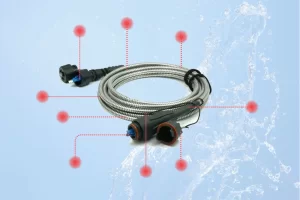






MTP/MPO fiber cables are widely used in modern data centers because they allow multiple optical fibers to be terminated within a single compact connector. As network speeds continue to move from 100G to 400G, 800G, and beyond, one specification has become increasingly important when selecting these cables: fiber core count.
MTP/MPO cables are commonly available in 8-fiber, 12-fiber, and 16-fiber configurations. However, a higher fiber count does not necessarily mean a better cable. The appropriate choice depends primarily on the optical lane architecture of the connected transceivers, the existing cabling system, and whether the cable will be used for direct connection, breakout, or future network expansion.
Understanding the differences between these core counts can help data center designers avoid unnecessary fiber usage while maintaining compatibility and scalability.
What Does the Fiber Core Number Mean?
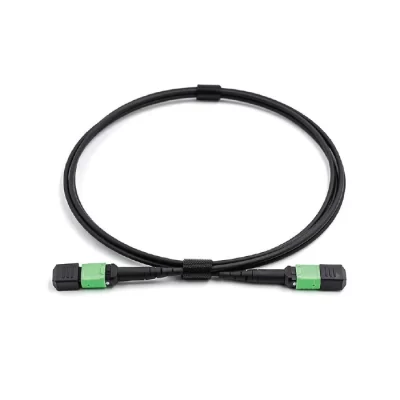
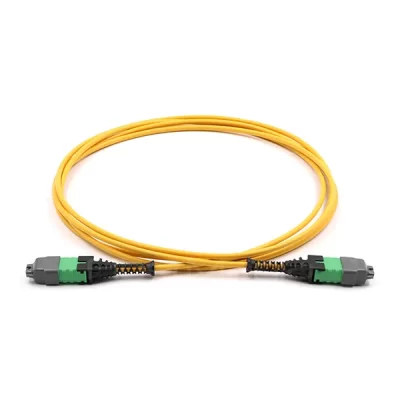
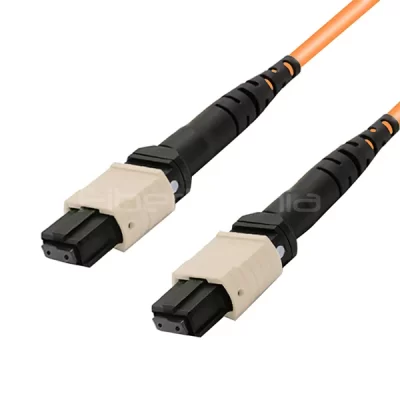
The core number indicates how many individual optical fibers are terminated within an MTP/MPO connector assembly. An MTP/MPO-8 cable contains eight fibers, while MTP/MPO-12 and MTP/MPO-16 cables contain twelve and sixteen fibers respectively.
The important point is that physical fiber count and active optical lanes are not always the same thing. An optical transceiver may contain a 12-fiber connector while using only eight fibers for actual transmission. Similarly, a 16-fiber cable may be required when an optical system uses eight transmit and eight receive fibers.
Therefore, selecting an MTP/MPO cable should begin with the optical architecture of the equipment rather than simply looking at the network speed.
For example, two transceivers may both support 400G but use different numbers of optical lanes. As a result, they may require different MTP/MPO cable configurations.
MTP/MPO Fiber Counts
The three configurations serve somewhat different purposes in modern and legacy fiber infrastructures. The following table provides a practical comparison.
This comparison also illustrates why choosing the largest available fiber count is not necessarily the best strategy. A cable should match the optical architecture as closely as possible while leaving reasonable room for the network’s future requirements.
| Fiber Count | Typical Architecture | Common Applications | Main Advantage | Typical Consideration |
| 8-Fiber | 4 Tx + 4 Rx | 40G SR4, 100G SR4/PSM4, 400G DR4-class | Efficient fiber utilization for 4-lane systems | Best when equipment uses 8 active fibers |
| 12-Fiber | Varies by application | 40G/100G legacy systems, structured cabling, existing MTP/MPO infrastructure | Broad compatibility with established cabling | Some applications may leave fibers unused |
| 16-Fiber | 8 Tx + 8 Rx | 400G/800G 8-lane systems, AI/HPC networks | Supports high lane counts in a single connector | May be unnecessary for lower-lane applications |
| 24-Fiber | Multiple parallel-fiber configurations | High-density trunk cabling, backbone links, data center interconnects, high-fiber-count deployments | Higher fiber density and greater cabling flexibility | Requires careful fiber mapping and infrastructure planning |
When Is 8-Fiber MTP/MPO the Right Choice?
Eight-fiber MTP/MPO cabling is closely associated with Base-8 parallel-optics architectures. In a typical 8-fiber configuration, four fibers are used for transmission and four for reception.
This makes 8-fiber cabling particularly suitable for applications such as 40G SR4 and 100G SR4/PSM4, as well as certain 400G DR4-class optical connections. It is also commonly used in MTP-to-LC breakout assemblies where one parallel-optics port needs to be connected to multiple duplex optical interfaces.
One of the main advantages of an 8-fiber architecture is efficient fiber utilization. When the transceiver requires exactly eight active fibers, there is little or no unused fiber capacity within the connector.
For new installations based on four-lane optical architectures, MTP/MPO-8 can therefore provide a clean and efficient cabling approach.
Why Is 12-Fiber MTP/MPO Still Widely Used?
Twelve-fiber MTP/MPO cabling has been part of data center fiber infrastructure for many years and remains common because of its large installed base. Many existing trunks, patch panels, cassettes, and structured cabling systems were designed around 12-fiber configurations.
In some applications, a 12-fiber connector may be paired with an optical system that actively uses only eight fibers. The remaining fibers may not participate in the transmission path. Although this can result in lower fiber utilization, it does not necessarily make the configuration unsuitable.
For networks that already have extensive 12-fiber infrastructure, maintaining the same core count can simplify upgrades and reduce the need to replace existing trunks and distribution components.
The important consideration is therefore infrastructure compatibility. A 12-fiber cable can be a sensible choice when it fits the existing architecture, but it should not automatically be selected for every new high-speed deployment.
Where Does 16-Fiber MTP/MPO Fit?
The growing use of higher-speed optical interfaces has increased the importance of 16-fiber MTP/MPO cabling. Eight-lane optical architectures typically require sixteen fibers when eight fibers are used for transmit and eight for receive.
This makes MTP/MPO-16 particularly relevant to certain 400G and 800G applications, where higher lane counts are required to achieve aggregate bandwidth.
For example, an 800G optical connection based on an 8-lane architecture can use a 16-fiber MTP/MPO connection for direct connectivity. The same fiber count can also support certain breakout and conversion architectures in which one high-speed interface is connected to multiple lower-speed interfaces.
As AI clusters, high-performance computing systems, and hyperscale data centers increasingly adopt 800G-class connectivity, 16-fiber cabling provides a practical way to accommodate higher optical lane density without requiring multiple parallel connectors for a single link.
When Should You Choose 24-Fiber MTP/MPO?
24-fiber MTP/MPO cabling is mainly valuable when the priority is fiber density and cabling efficiency rather than simply matching a single optical transceiver’s lane count. By consolidating 24 individual fibers into a compact MTP/MPO assembly, it can reduce the number of parallel cables required in high-density backbone and interconnection environments.
Unlike 8-fiber and 16-fiber configurations, which are often selected according to the active lane architecture of a specific optical transceiver, 24-fiber cables are frequently used as high-density trunk or backbone infrastructure. They can provide additional fiber capacity between patch panels, distribution areas, and equipment zones while allowing the fibers to be allocated to different links through appropriate breakout, conversion, or patching solutions.
This makes 24-fiber MTP/MPO particularly useful in large data centers where a large number of optical connections must be transported between locations with limited rack space and cable-management capacity. It can also be advantageous when the cabling infrastructure is expected to support multiple generations of optical equipment rather than being dedicated to one specific transceiver type.
However, a higher fiber count does not automatically mean better performance. A 24-fiber cable may contain significantly more fibers than a particular optical link requires, so it is important to distinguish between cable-level fiber density and transceiver-level active fiber requirements. The choice should be based on the overall cabling architecture, available patching equipment, polarity design, and future expansion requirements.
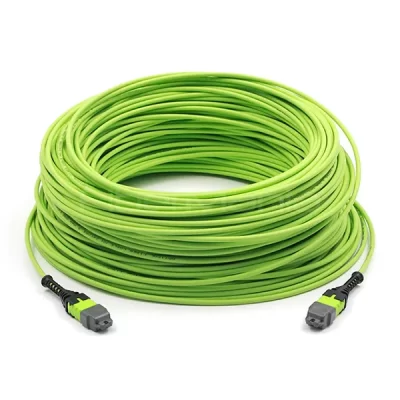
Core Count Should Follow the Optical Lane Architecture
One of the easiest mistakes when selecting MTP/MPO cables is choosing according to the headline data rate alone.
A better approach is to start with the transceiver specification and determine how many optical lanes it uses. The relationship can be simplified as follows:
Data rate → Optical lane architecture → Active fiber count → MTP/MPO configuration
For instance, a four-lane optical architecture generally requires eight fibers for a bidirectional connection, while an eight-lane architecture may require sixteen. The transmission rate itself does not directly determine the physical fiber count.
This distinction becomes increasingly important at 400G and 800G because different optical standards can achieve the same aggregate bandwidth using different lane configurations.
Existing Infrastructure vs. New Deployment
The best core count can also depend on whether the network is being built from scratch or upgraded from an existing fiber infrastructure.
For a new data center deployment, it is generally easier to select a cabling architecture that closely matches the optical modules and anticipated future upgrades. An 8-fiber Base-8 architecture can be attractive for systems built around four-lane optics, while 16-fiber cabling may make more sense for environments expected to adopt higher-density 8-lane connectivity.
An existing data center presents a different situation. If the facility already relies heavily on 12-fiber trunks and MTP/MPO distribution modules, replacing the entire cabling system simply to achieve a different core count may not be economically justified. In such cases, compatibility with existing infrastructure can be more important than achieving maximum theoretical fiber utilization.
The right decision is therefore a balance between current equipment requirements, existing infrastructure, and future migration plans.
Don’t Choose Core Count in Isolation
Fiber count is only one part of an MTP/MPO cable specification. Before placing an order, the complete optical link should be considered.
Fiber type is particularly important. Multimode OM3, OM4, or OM5 and single-mode OS2 fibers serve different transmission requirements and distances. Connector gender and key orientation must also match the connected equipment and cabling architecture.
Polarity is another critical consideration. MTP/MPO systems can use different polarity methods to correctly align transmit and receive channels. A cable with the correct fiber count can still fail to establish a link if its polarity does not match the system design.
The transceiver’s connector interface, optical lane count, transmission distance, wavelength, and breakout requirements should therefore all be verified together with the fiber core count.
Which MTP/MPO Core Count Should You Choose?
There is no universal answer to whether 8-fiber, 12-fiber, or 16-fiber MTP/MPO is the “best” option. Each configuration has a practical role in fiber infrastructure.
MTP/MPO-8 is commonly associated with four-lane parallel-optics systems, while MTP/MPO-12 remains widely used in established data center infrastructures. MTP/MPO-16 is increasingly relevant to 8-lane 400G and 800G applications, while MTP/MPO-24 provides greater fiber density for trunk, backbone, and large-scale data center interconnection. The right choice ultimately depends on whether the priority is matching active optical lanes, maintaining compatibility with existing infrastructure, or maximizing fiber density and future scalability.
The most reliable selection principle is simple: choose the fiber count based on the optical architecture, not the bandwidth number alone.
As data center networks continue to evolve toward higher speeds and greater port density, understanding MTP/MPO core numbers will become increasingly important. Selecting the appropriate configuration at the planning stage can reduce unused fiber capacity, simplify connectivity, improve compatibility, and provide a more practical foundation for future network upgrades.
Frequently Asked Questions
1. What are the most common MTP/MPO fiber core counts?
The most common configurations are 8-fiber, 12-fiber, 16-fiber, and 24-fiber. Each serves a different purpose: 8-fiber cables are widely used for four-lane parallel optics, 12-fiber cables remain common in established infrastructure, 16-fiber cables support many 8-lane applications, and 24-fiber cables are often used for high-density trunk and backbone cabling.
2. Does a higher MTP/MPO fiber count always mean better performance?
No. A higher fiber count does not automatically provide higher transmission speed or better optical performance. The appropriate core count should match the optical lane architecture and cabling design. Choosing a 24-fiber cable for a link that only requires eight active fibers, for example, may provide additional capacity but does not make the individual optical link faster.
3. When should I choose 8-fiber, 12-fiber, or 16-fiber MTP/MPO cabling?
The choice should primarily depend on the connected transceivers and existing infrastructure. 8-fiber is well suited to four-lane parallel-optics applications, 12-fiber is practical for many established MTP/MPO systems, and 16-fiber is increasingly suitable for high-density 8-lane 400G and 800G applications. The transceiver’s actual fiber and lane requirements should always be checked before selection.
4. What is 24-fiber MTP/MPO cable typically used for?
24-fiber MTP/MPO cables are particularly useful for high-density trunk, backbone, and data center interconnection applications. Instead of being selected solely to match one optical transceiver, they are often used to consolidate a larger number of fibers between distribution points, patch panels, or equipment areas. They can provide greater fiber capacity while reducing cable-management complexity in large-scale deployments.
5. What should I check besides the MTP/MPO fiber core count?
Fiber core count is only one part of MTP/MPO cable selection. You should also verify the fiber type, connector type, connector gender, key orientation, polarity, transceiver interface, optical lane architecture, transmission distance, and breakout requirements. Matching all of these parameters is essential to ensure compatibility and reliable operation, particularly in high-speed 400G and 800G networks.