Skip to content

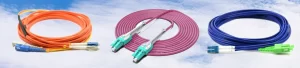
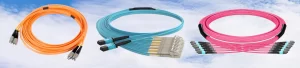































As optical communication networks have evolved, the way optical fibers are connected has changed from relatively simple point-to-point links to increasingly dense, parallel optical interconnection systems. In the early stages of fiber-optic networking, most connections involved individual fibers, and the demand for compact multi-fiber connectors was relatively limited. As data transmission requirements grew and fiber counts increased, however, manufacturers began looking for more efficient ways to terminate and connect multiple fibers within a single connector. This development eventually led to technologies such as MT ferrules and MPO/MTP connectors, which established a practical foundation for multi-fiber connectivity in data centers and other high-density optical networks.
Today, the growth of 400G, 800G and higher-speed optical systems has made multi-fiber connectivity increasingly important. A single optical connection may need to accommodate many parallel channels while occupying very little physical space. This creates a manufacturing challenge that is fundamentally different from conventional single-fiber termination: the objective is no longer simply to align one fiber with another, but to maintain the precise position, spacing and geometry of an entire fiber array. The evolution of multi-fiber patch cord manufacturing can therefore be understood as a continuous effort to improve how optical fibers are arranged, aligned, fixed, polished and tested as the density of optical interconnections increases.
From Single-Fiber Connections to Multi-Fiber Connectivity
The earliest generations of fiber-optic networks relied heavily on individual fiber connections. This approach was practical when transmission capacity requirements were relatively modest because each connection involved only one optical channel and the physical space required for connectors and patching systems was not a major limitation. As networks expanded, however, the number of fibers within telecommunications and data center infrastructure increased significantly. Managing large numbers of individual connections began to consume more rack space, increase installation complexity and make fiber management more difficult.
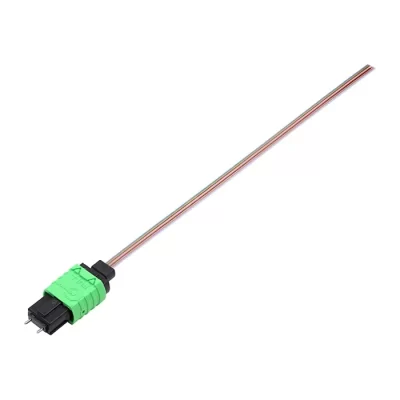
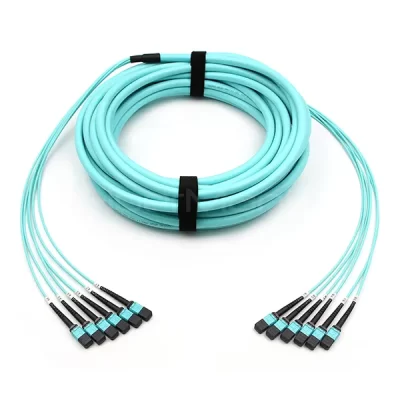
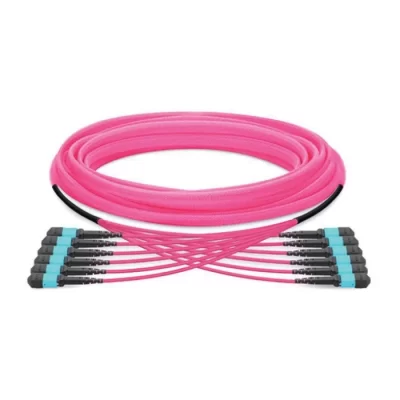
The industry gradually moved toward multi-fiber technologies that could combine several optical channels into a single connection. MT-based connector technology provided an important step in this transition by introducing a precision ferrule capable of positioning multiple fibers in a defined array. MPO and later MTP connector systems built on this principle and provided a practical, standardized approach to connecting multiple fibers through a compact interface. Instead of terminating and connecting every fiber separately, manufacturers could create a single connector containing an organized group of fibers, greatly improving the density and efficiency of optical interconnection systems.
At that stage, the manufacturing challenge was already becoming more demanding. A connector containing multiple fibers could no longer rely on the alignment principles used for a single-fiber connector. Every fiber needed to occupy its designated position, and the relative spacing between fibers had to remain consistent. The manufacturing process therefore evolved from individual fiber handling toward controlled fiber-array assembly.
Why Fiber Alignment Became a Manufacturing Priority
The fundamental difficulty of multi-fiber termination is that optical performance depends on geometry. In a single-fiber connection, the alignment process focuses primarily on matching one fiber core with another. In a multi-fiber connection, the same requirement exists across an entire array, and a positional error in one channel can affect the performance of that particular channel even when all other fibers are correctly positioned.
This makes fiber sequence, spacing and height important manufacturing parameters. The fibers must be arranged in the correct order before they are introduced into the connector, while their relative positions must remain stable throughout insertion, bonding and polishing. As the number of fibers increases, maintaining this consistency becomes more difficult because there are more positions to control and more opportunities for mechanical variation.
For this reason, modern multi-fiber manufacturing is based on a fundamental shift in approach: instead of treating every optical fiber as an independent component, manufacturers increasingly handle groups of fibers as a controlled array. The purpose of this approach is not only to improve production speed, but also to reduce variation and make the final geometry more repeatable.
From Individual Fibers to a Controlled Fiber Array
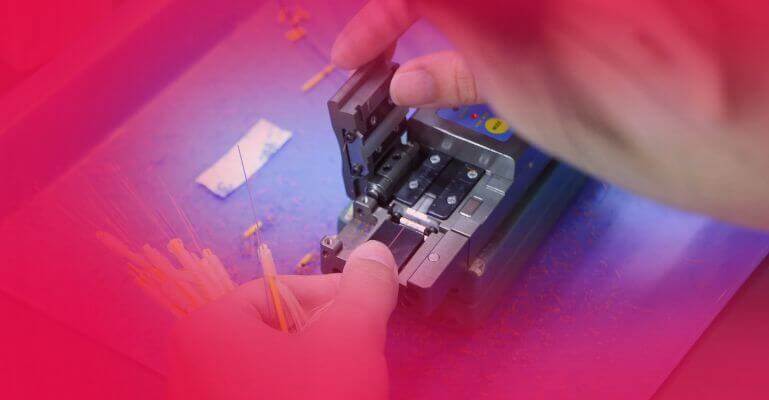
The transition from individual fiber handling to array-based manufacturing is one of the most important developments in multi-fiber connector production. Before termination, fibers must be stripped and cleaned, and their sequence must be established according to the intended connector configuration. Depending on the cable construction and application, ribbonized fiber or other fiber-arrangement techniques can help maintain the required relationship between multiple fibers.
Once the fibers have been organized into an array, the manufacturing process becomes much more manageable. Rather than attempting to locate each fiber independently inside a small connector, production tooling can maintain the relative position of the fibers while the entire array is transferred into the ferrule. This is particularly important for configurations such as 12-fiber and 24-fiber MPO/MTP assemblies, where the individual fibers are packed into a very small space.
The principle can be summarized simply: the earlier the manufacturing process can establish a stable and repeatable fiber array, the less dependent the final assembly becomes on individual fiber positioning. This transition from individual handling to group alignment is one of the key reasons why multi-fiber connectors can be manufactured efficiently at scale.
MT Ferrules as the Mechanical Reference for Multi-Fiber Alignment
The MT ferrule plays a central role in this process because it provides the precise mechanical structure that defines the final fiber positions. Rather than relying on an operator to determine the position of every fiber visually, the ferrule contains precisely manufactured fiber holes that establish the intended array geometry. During assembly, the prepared fibers are inserted into these positions and then fixed in place.
This changes the nature of the manufacturing problem. The question is no longer how to manually determine where each individual fiber should be located, but how to transfer a prepared fiber array into a precision ferrule while preserving its sequence and geometry. Specialized fixtures and insertion tooling help maintain this relationship during assembly, allowing multiple fibers to be handled as a group.
This is one of the fundamental differences between multi-fiber and single-fiber connector manufacturing. The ferrule provides a mechanical reference, while the fiber-array preparation and assembly process ensures that the fibers arrive at that reference in the correct order and orientation. The combination of these two elements makes high-density multi-fiber termination practical.
Fixing the Fiber Array Without Losing Its Accuracy
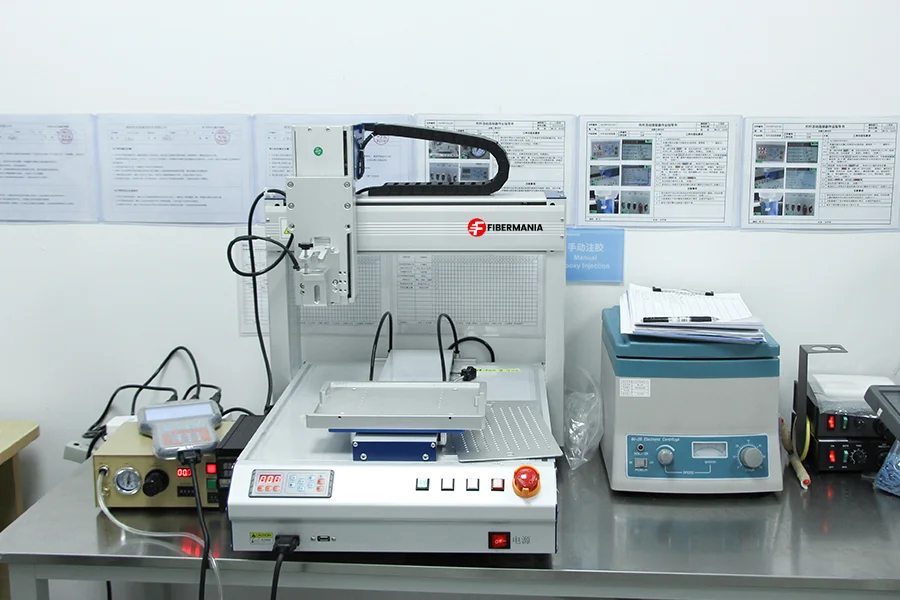
Once the fibers have been positioned within the ferrule, they must be secured so that their relative positions remain stable during subsequent processing. Adhesive bonding is commonly used for this purpose, but the bonding process itself must be carefully controlled. If the adhesive introduces excessive shrinkage or mechanical stress during curing, the fiber positions established during alignment can shift.
This is why precision manufacturing does not end once the fibers enter the ferrule. The alignment achieved during insertion must survive the fixation and curing process. Production improvements have therefore focused not only on faster fiber insertion, but also on more consistent adhesive application, controlled curing conditions and improved mechanical fixtures that minimize fiber movement.
As multi-fiber assemblies become denser, these process controls become increasingly important. A small positional change may have little significance in a rough mechanical assembly, but it can become significant when several optical channels must maintain consistent alignment across a compact connector end face.
Precision Polishing Completes the Optical Interface
The next major stage is end-face grinding and polishing. This process is particularly important because the final optical connection depends on the geometry of the entire ferrule end face, not merely on whether each fiber is located in the correct hole.
During polishing, manufacturers need to control the relationship between the fiber cores and the ferrule surface, including fiber protrusion or recession, end-face geometry and surface quality. The objective is to produce an end face in which all channels can form a stable and predictable optical interface with the mating connector.
This becomes increasingly challenging as the fiber count grows. With multiple fibers sharing one end face, variations in fiber height or polishing behavior can produce differences between channels. The polishing process therefore needs to maintain a high degree of uniformity across the entire array.
In this sense, precision alignment is a continuous manufacturing process rather than a single operation. It begins with fiber arrangement, continues through ferrule insertion and adhesive curing, and ultimately extends through grinding, polishing and inspection. A fiber that is correctly positioned at the beginning of the process can still contribute to poor connector performance if its final end-face geometry is not properly controlled.
The Role of Automation in High-Density Production
As demand for multi-fiber connectivity increased, manual assembly became increasingly difficult to scale. Early production could rely more heavily on skilled operators because fiber counts and production volumes were relatively limited. As the market expanded, manufacturers began introducing more specialized fixtures, alignment tools, automated fiber-handling systems, machine vision and inspection equipment.
The purpose of automation is not simply to make production faster. More importantly, it allows manufacturers to make the same alignment operation repeatable across large numbers of connectors. Automated or semi-automated systems can control fiber positioning, insertion depth, adhesive application and inspection more consistently than processes that depend entirely on manual manipulation.
This development has become particularly important as the industry has moved toward higher fiber counts and smaller connector footprints. When a connector contains many optical channels, production quality depends increasingly on process repeatability rather than individual operator skill. Automation therefore becomes a natural extension of the same principle that drove the adoption of fiber arrays in the first place: controlling multiple fibers as a coordinated system.
From MPO/MTP to the Next Generation of High-Density Connectivity
The evolution of multi-fiber manufacturing has closely followed the evolution of optical network requirements. When optical systems primarily relied on individual fiber connections, highly compact multi-fiber termination was less critical. As data centers began deploying larger numbers of optical links, MPO/MTP provided an efficient way to consolidate multiple channels into a compact connection. With the emergence of 40G and 100G parallel optical applications, multi-fiber connectivity became increasingly important, while the transition to 400G, 800G and future higher-speed architectures has further increased the demand for compact, high-density optical interconnection.
This progression has also changed the manufacturing priorities. Earlier multi-fiber production focused on achieving reliable fiber positioning and consistent connector performance. Modern production must achieve those same goals at higher volumes while supporting increasingly dense architectures. The emphasis has therefore expanded from basic mechanical alignment to automated fiber-array handling, tighter process control, improved polishing consistency and comprehensive multi-channel inspection.
At the same time, new high-density connector technologies are emerging alongside established MPO/MTP systems. Technologies such as MDC, SN and other compact multi-fiber or very-small-form-factor connectivity solutions reflect the same broader trend: more optical channels must be accommodated within smaller physical spaces without compromising optical performance.
Fiber Array Technology as a Broader Manufacturing Principle
The principles used in multi-fiber patch cord manufacturing also appear in other areas of optical technology. Fiber arrays and Fiber Array Units (FAUs), for example, are used where multiple optical fibers must be positioned accurately relative to optical components such as optical engines, photonic devices, PLC splitters or other integrated optical structures.
An FAU is not the same component as an MT ferrule or an MPO connector, and ordinary MPO patch cord manufacturing does not require an FAU as a direct production component. However, the technologies share an important engineering principle: multiple optical fibers must be arranged and maintained as a precise geometric array. The same emphasis on fiber spacing, positioning, fixation and end-face or coupling accuracy appears across both connector manufacturing and photonic packaging.
This common foundation becomes increasingly relevant as data center connectivity and photonic integration begin to converge. High-density optical systems require not only more fibers, but also more precise methods for positioning those fibers relative to connectors, transceivers, optical engines and photonic chips.
The Future of Multi-Fiber Manufacturing
The history of multi-fiber patch cord manufacturing is essentially a history of increasing density and increasing process precision. What began as a practical solution for connecting several fibers more efficiently has developed into a sophisticated manufacturing discipline in which fiber arrays, precision ferrules, controlled bonding, high-accuracy polishing and automated inspection work together to maintain consistent optical performance.
As network speeds continue to increase, the industry will face the same fundamental challenge at an even smaller scale: how to accommodate more optical channels while maintaining precise alignment and reliable connections. Future manufacturing processes will therefore continue to emphasize automation, machine vision, precision array handling, tighter dimensional control and more efficient testing.
The key lesson is that high-density multi-fiber connectivity is not achieved simply by adding more fibers to a connector. It requires a manufacturing process capable of treating those fibers as one precisely controlled optical array from the earliest stages of preparation through final testing. This evolution in alignment and assembly technology is what has allowed MPO/MTP and other multi-fiber connectivity platforms to support the growing density requirements of modern data centers and high-speed optical networks.