Skip to content















































Outdoor optical cabinets play an important role in modern FTTx, PON, CATV and other fiber access networks. Positioned between the central office and the subscriber side, these cabinets provide a convenient location for optical distribution, splicing, branching and network management. As the number of connected users and optical services continues to increase, passive optical components installed inside these cabinets must provide reliable optical performance while fitting into increasingly compact spaces.
Fiber splitters are among the key passive components used for optical signal distribution. However, selecting a suitable splitter for an outdoor cabinet involves more than simply choosing the required split ratio. Temperature fluctuations, humidity, mechanical stress, limited installation space and long-term maintenance requirements all need to be considered.
For applications requiring low channel counts and compact packaging, the mini steel tube fiber splitter, particularly the Fused Biconic Tapered (FBT) type, provides a practical solution. Its small stainless-steel housing protects the internal fused fiber coupling area while allowing the component to be installed in splice trays, fiber management spaces and other confined areas inside outdoor cabinets.
Why Fiber Splitters in Outdoor Cabinets Require Careful Selection
Outdoor optical cabinets protect internal components from direct exposure to the surrounding environment, but they do not completely eliminate environmental stress. The temperature inside a cabinet can vary significantly throughout the day, particularly when the enclosure is exposed to direct sunlight. In cold climates, the same cabinet may experience sub-zero temperatures during winter.
Repeated temperature changes can affect the optical and mechanical stability of inadequately packaged components. Moisture and condensation can create additional risks, while routine maintenance activities may expose fiber components to pulling, bending or accidental impact.
Space is another important consideration. An outdoor cabinet may already contain fiber splice trays, adapters, cable management components, PLC splitters, connectors and incoming and outgoing cables. Installing a large splitter module can make fiber routing more difficult and consume valuable internal space.
For these reasons, an outdoor-cabinet splitter needs to achieve a balance between optical stability, mechanical protection, environmental resistance and compact packaging.
What Is a Mini Steel Tube Fiber Splitter?
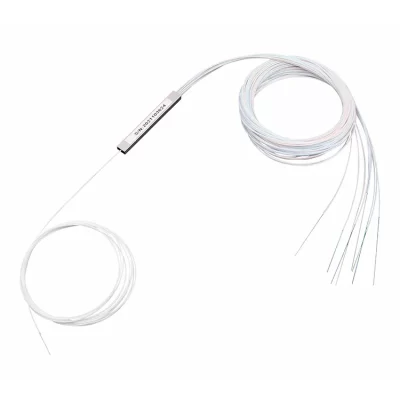
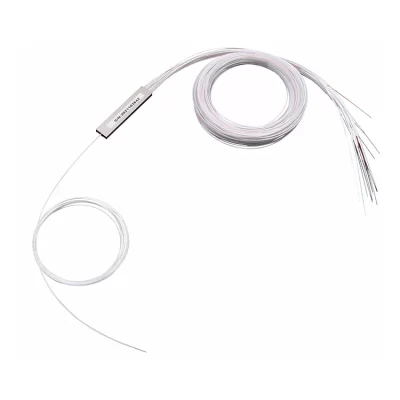
A mini steel tube fiber splitter is a compact optical splitter packaged inside a small stainless-steel tube. In FBT versions, the optical coupling region is produced by bringing two or more optical fibers together and thermally fusing and tapering them to create the required power distribution.
The fused optical region is then protected inside the metal tube, while optical fibers extend from the housing as pigtails. Depending on the application, the pigtails can use 250 μm fiber or more mechanically protected 900 μm configurations.
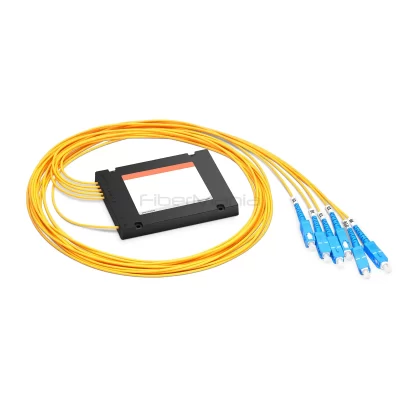
Unlike larger ABS or box-style splitter enclosures, the steel tube package does not require a large external housing. This makes it particularly useful when the splitter must be integrated into a splice tray or installed in a narrow space within an optical distribution cabinet.
Depending on network requirements, mini steel tube splitters can be supplied with different fiber types, pigtail lengths, connector configurations, operating wavelength ranges and split ratios.
Compact Packaging for High-Density Outdoor Cabinets
One of the primary advantages of the mini steel tube design is its small footprint.
Modern outdoor cabinets increasingly need to accommodate more fiber connections without continuously increasing cabinet dimensions. A compact splitter can be positioned alongside splice trays and cable routing areas without occupying the space required by a larger standalone enclosure.
The stainless-steel tube also provides a defined protective structure around the fused coupling region. During installation and maintenance, technicians are less likely to directly handle the most sensitive part of the optical component.
This compact form factor is especially useful for 1×2, 1×3 and 1×4 configurations, where only a small number of optical outputs are required.
Stainless-Steel Housing for Better Mechanical Protection
The fused region of an FBT splitter is a precision optical structure and therefore requires protection after manufacturing. The stainless-steel tube provides mechanical reinforcement around this region and helps reduce the risk of physical damage during installation and routine cabinet maintenance.
The sealed or appropriately protected tube structure can also help isolate the internal optical coupling area from external dust and moisture. This is particularly valuable in outdoor cabinets where condensation, humidity and contaminants may accumulate over long service periods.
However, the environmental performance of a complete splitter assembly depends on its specific construction, sealing method, fiber coating, pigtail configuration and manufacturing process. Therefore, engineers should evaluate the manufacturer’s actual temperature, humidity, mechanical and reliability specifications rather than judging outdoor suitability solely from the metal housing.
Optical Performance and Split Ratio Selection
The purpose of a fiber splitter is to divide optical power between multiple output paths while maintaining acceptable optical loss and stability.
For FBT splitters, the most common configuration is 1×2, with equal splitting between the two output fibers. An approximately 50:50 split is suitable when two downstream paths require similar optical power.
Unequal split ratios can also be manufactured for applications where different optical power levels are required. Examples include 70:30, 80:20, 90:10 and other customized configurations. These ratios can be useful for optical monitoring, tapping or applications where one path requires significantly more optical power than another.
The actual insertion loss, excess loss, polarization-dependent loss, return loss and directivity depend on the splitter design and production quality. For this reason, these parameters should be specified according to the requirements of the particular network rather than relying on a generic value.
Wavelength is equally important. FBT technology can be manufactured for specific wavelength bands or broader operating bands. Network designers should therefore confirm whether the splitter will be used for 1310 nm, 1490 nm, 1550 nm, 1625 nm or a wider wavelength range before ordering.
Fiber and Connector Options
The fiber configuration is another important consideration for outdoor cabinet installation.
A 250 μm bare fiber configuration offers excellent flexibility and occupies very little space, but the exposed fiber structure requires greater care during installation and splicing. A 900 μm fiber configuration provides additional mechanical protection and is often easier for technicians to handle, route and organize inside a cabinet.
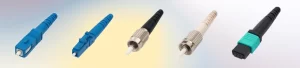
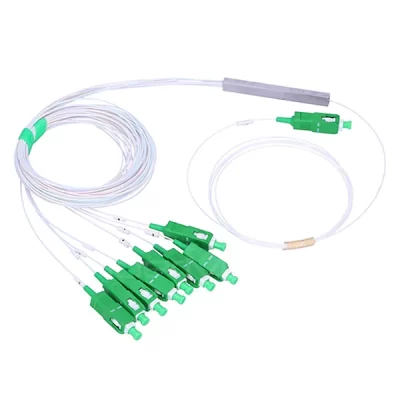
Connectorized versions can also simplify installation. Common connector options include SC/APC, SC/UPC, LC/UPC, FC/APC and ST, depending on the adapter system used inside the cabinet.
For PON applications, APC connectors are frequently selected because they provide low back reflection and are widely used in optical access networks. The connector type, polishing style and fiber type should always match the corresponding adapters and optical equipment.
Mini Steel Tube FBT vs. PLC Splitter
Mini steel tube FBT splitters and PLC splitters can both be used for optical power distribution, but they are not interchangeable in every application.
FBT technology is particularly practical for low split counts and customized unequal splitting ratios. Its relatively simple construction can make it an economical option for applications such as 1×2 or 1×4 branching and optical tapping.
PLC splitters, on the other hand, are widely used for higher split counts and applications requiring more uniform splitting across multiple output ports. Configurations such as 1×8, 1×16, 1×32 and 1×64 are common in PON networks.
The choice should therefore be based on split count, wavelength requirements, uniformity, packaging, available cabinet space and project cost rather than treating FBT or PLC as universally better.
| Feature | Mini Steel Tube FBT Splitter | PLC Splitter |
|---|---|---|
| Typical application | Low-count splitting and tapping | Medium- to high-count optical distribution |
| Common configurations | 1×2, 1×3, 1×4 | 1×4, 1×8, 1×16, 1×32, 1×64 |
| Split ratio | Equal or customized unequal ratios | Usually equal splitting |
| Packaging | Miniature steel tube | Chip-based module, cassette or box |
| Space requirement | Very low | Depends on package |
| Suitable for optical tapping | Excellent | Less flexible for asymmetric tapping |
| Typical cabinet use | Compact distribution and monitoring | Higher-density PON distribution |

Installation Considerations Inside Outdoor Optical Cabinets
A reliable splitter can still experience performance problems if it is installed incorrectly. Fiber routing should therefore be planned before the splitter is fixed inside the cabinet.
The steel tube should be positioned so that it is not compressed by other cables or components. The pigtails should follow appropriate bending-radius requirements and should not be forced into sharp turns. Excessive bending can increase optical loss and create unnecessary mechanical stress on the fiber.
The splitter should also be securely positioned. Allowing the component to move freely inside a cabinet can expose the pigtails to repeated mechanical movement whenever cables are handled or the cabinet door is opened and closed.
Connectorized splitters should be installed with appropriate connector protection and dust caps where required. Any unused optical port should remain properly protected from contamination.
For fusion-splicing applications, the splitter pigtails should be routed to the designated splice tray and protected using the cabinet’s normal fiber management system.
It is also good practice to leave sufficient space around the splitter for future inspection and maintenance. A compact component should save cabinet space without making future troubleshooting more difficult.
Applications in FTTx and PON Networks
Mini steel tube fiber splitters are particularly useful in access networks where a small number of optical paths must be branched inside a compact outdoor enclosure.
In FTTx deployments, an outdoor cabinet can function as a secondary distribution point between feeder fibers and downstream distribution cables. A 1×2 or 1×4 splitter can divide an incoming optical signal into several downstream paths according to the network architecture.
For smaller access nodes, this approach can avoid the need for a larger splitter enclosure while keeping the optical distribution structure relatively simple.
In PON networks, however, the appropriate splitter type depends on the overall optical budget and split architecture. A small FBT splitter may be suitable for a localized branching stage, while PLC technology is generally more practical when a large number of subscribers must be served from a single optical input.
CATV Optical Distribution
Fiber-based CATV networks also require optical signal distribution between headend equipment and multiple downstream locations.
A mini steel tube splitter can be installed inside an outdoor optical cabinet to divide an incoming optical CATV signal toward different distribution routes. Its compact packaging allows it to coexist with splice trays and fiber management components without requiring a dedicated large enclosure.
For CATV applications, wavelength compatibility and optical power budget are particularly important. The splitter should be selected according to the actual transmission wavelength and required optical output power.
Optical Monitoring and Signal Tapping
Another useful application is optical signal monitoring.
Instead of dividing an optical signal equally between multiple downstream paths, an asymmetric FBT splitter can divert a small percentage of optical power toward a monitoring or test device while allowing most of the signal to continue along the primary transmission path.
For example, a high-ratio configuration can be designed so that only a small portion of the optical signal is tapped for monitoring. This approach can be useful for network diagnostics, performance monitoring and maintenance systems.
The exact ratio should be determined according to the sensitivity of the monitoring equipment and the available optical power budget.
How to Choose the Right Mini Steel Tube Fiber Splitter
When specifying a mini steel tube fiber splitter for an outdoor optical cabinet, several parameters should be confirmed before procurement.
First, determine the input and output configuration, such as 1×2, 1×3 or 1×4. The required number of downstream paths directly affects the splitter architecture.
Next, define the splitting ratio and operating wavelength. Equal splitting is suitable for balanced distribution, while unequal splitting may be required for monitoring or specialized optical power allocation.
The fiber type and pigtail length should then be selected according to the cabinet’s internal routing structure. A 900 μm pigtail can provide additional handling protection, while 250 μm fiber may be preferable when extremely compact routing or direct fusion splicing is required.
The connector configuration should match the cabinet’s adapter panels and optical equipment. SC/APC and LC/UPC are common choices, but other connector types may be specified for particular systems.
Finally, evaluate the operating temperature, environmental protection, optical performance and mechanical reliability against the actual installation environment. For harsh outdoor deployments, project specifications should be verified through the manufacturer’s test data and applicable industry standards.
Conclusion
The mini steel tube fiber splitter provides a compact and practical method of optical signal branching inside outdoor optical cabinets. Its small stainless-steel package protects the internal fused optical coupling region while allowing the component to be integrated into space-constrained fiber management environments.
For low-count applications such as 1×2 and 1×4 splitting, FTTx distribution, CATV branching and optical monitoring, the combination of compact packaging, flexible split ratios and customizable fiber and connector configurations makes this type of splitter a useful passive network component.
Nevertheless, the best splitter is determined by the complete network design rather than by package size alone. Split ratio, wavelength, optical budget, fiber configuration, connector type, environmental conditions and available cabinet space should all be evaluated together.
When properly specified and installed, a mini steel tube fiber splitter can simplify optical distribution inside outdoor cabinets while helping network operators achieve reliable long-term performance and efficient fiber management.
Frequently Asked Questions
1. What is a mini steel tube FBT fiber splitter?
A mini steel tube FBT fiber splitter is a compact passive optical splitter that uses Fused Biconic Tapered (FBT) technology to divide optical power between multiple fiber paths. Its fused coupling region is protected inside a small stainless-steel tube, making it suitable for space-constrained applications such as outdoor optical cabinets, splice trays, FTTx networks and CATV distribution systems.
2. What is the difference between an FBT splitter and a PLC splitter?
The main difference is their splitting technology and typical application. FBT splitters are particularly suitable for low split counts and can support customized unequal split ratios, making them useful for 1×2, 1×3, 1×4 and optical tapping applications. PLC splitters generally provide more uniform splitting across multiple outputs and are widely used for higher-density configurations such as 1×8, 1×16, 1×32 and 1×64 in PON networks.
3. Why are mini steel tube FBT splitters suitable for outdoor optical cabinets?
Their compact stainless-steel housing provides mechanical protection for the fused optical coupling area while occupying very little installation space. This makes them easy to integrate into fiber splice trays and other crowded cabinet environments. When properly specified and manufactured, they can also provide reliable performance under temperature fluctuations, humidity and routine mechanical handling.
4. How do I choose the right split ratio for a mini steel tube fiber splitter?
The required split ratio depends on the network architecture and optical power budget. Equal ratios such as 50:50 are suitable when optical power needs to be divided relatively evenly between two paths. Unequal ratios, such as 90:10 or 95:5, are more appropriate for optical monitoring, signal tapping or applications where one output requires significantly more optical power than another.
5. Can mini steel tube FBT splitters be used in PON and CATV networks?
Yes. Mini steel tube FBT splitters can be used in PON and CATV networks when their wavelength range, insertion loss, split ratio and optical power handling meet the requirements of the system. They are especially useful for low-count branching and localized optical distribution inside outdoor cabinets, while PLC splitters are generally more suitable when a PON architecture requires a larger number of evenly distributed outputs.