Skip to content




















Ethernet cables are the backbone of modern networking, supporting everything from home internet connections to enterprise data centers. While categories like Cat5e, Cat6, and Cat6A are widely discussed, the shielding types—UTP, FTP, STP, and SFTP—are equally important in determining performance, interference resistance, and installation suitability.
This article provides a comprehensive guide to Ethernet cable shielding types, explains their differences, and helps you choose the right cable for your networking environment.
What Does Cable Shielding Mean?
Shielding refers to the protective layers within an Ethernet cable that reduce electromagnetic interference (EMI) and radio frequency interference (RFI). These interferences can degrade signal quality, especially in environments with high electrical noise such as industrial facilities, data centers, or areas with dense cabling.
Shielding is typically applied either to the entire cable or to individual twisted pairs inside the cable.
Main Types of Ethernet Cable Shielding
UTP (Unshielded Twisted Pair)
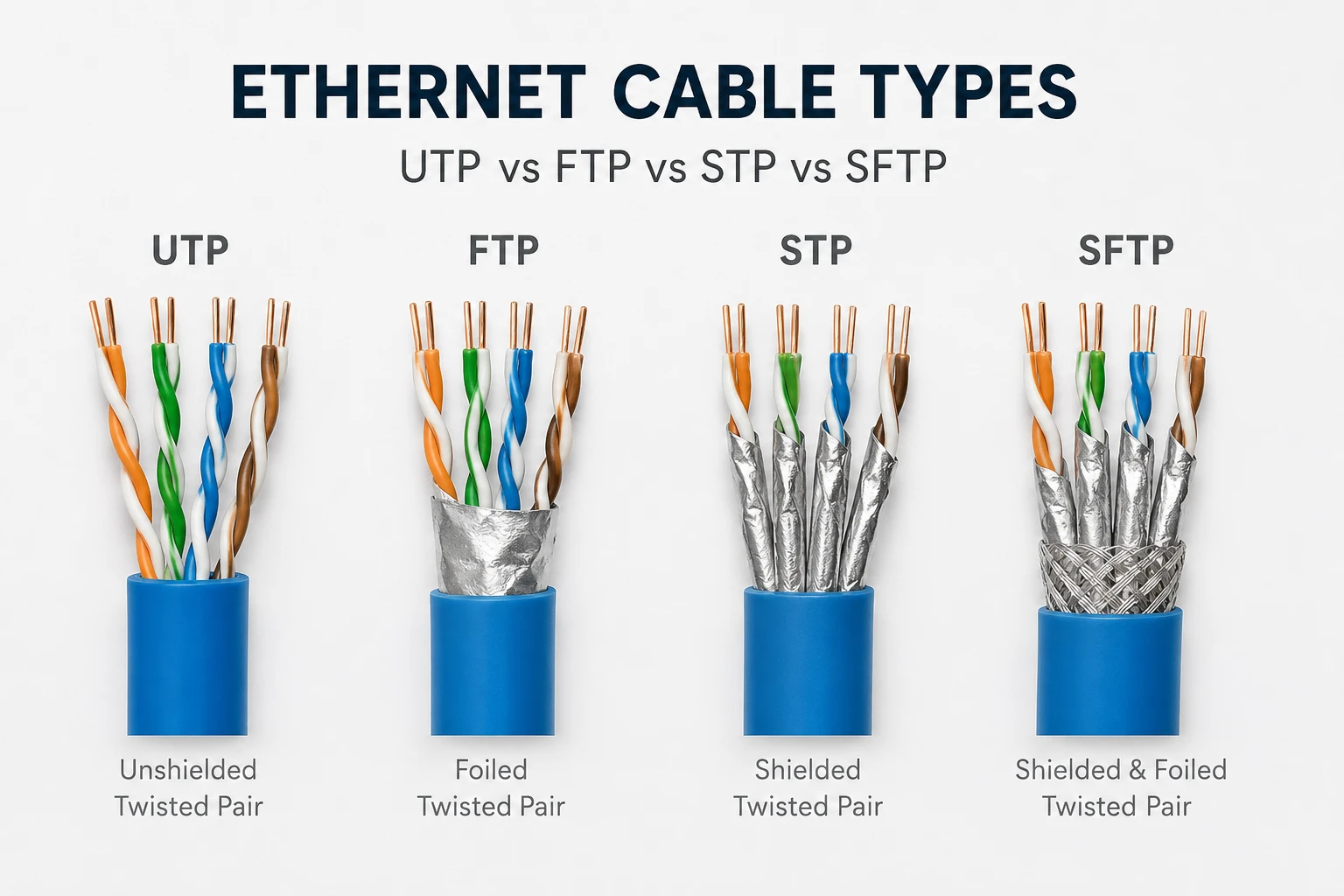
UTP is the most common and widely used Ethernet cable type. It contains no additional shielding beyond the twisted pairs themselves. The twisting helps reduce interference, but there is no metallic shielding.
UTP cables are lightweight, flexible, and cost-effective, making them ideal for home networks, offices, and environments with minimal electromagnetic interference.
FTP (Foiled Twisted Pair)
FTP cables include a single layer of aluminum foil wrapped around all twisted pairs. This overall shielding provides better protection against EMI compared to UTP.
FTP is suitable for moderately noisy environments, such as commercial buildings or installations near electrical wiring.
STP (Shielded Twisted Pair)
STP cables typically feature individual shielding around each twisted pair. This design significantly reduces crosstalk between pairs and improves signal integrity.
They are often used in environments where signal quality is critical, such as industrial systems or high-performance networking setups.
SFTP (Shielded and Foiled Twisted Pair)
SFTP cables combine both overall shielding and individual pair shielding. Each twisted pair is shielded, and an additional foil or braided shield wraps the entire cable.
This provides maximum protection against EMI and crosstalk, making SFTP ideal for data centers, outdoor installations, and high-interference environments.
Additional Shielding Classifications
Beyond the commonly known types, Ethernet cables are also classified using a more precise naming convention defined by ISO/IEC standards:
- F/UTP: Overall foil shielding, no individual pair shielding (commonly called FTP)
- U/FTP: No overall shielding, but each pair is individually foil-shielded
- SF/UTP: Combination of foil and braid shielding around the cable, no individual shielding
- S/FTP: Braided overall shield plus individual foil shielding (often referred to as SFTP)
This naming system provides a clearer understanding of how shielding is applied.
Shielding Comparison Table
| Cable Type | Shielding Structure | EMI Protection | Flexibility | Cost | Typical Applications |
|---|---|---|---|---|---|
| UTP | None | Low | High | Low | Home, office LAN |
| FTP (F/UTP) | Overall foil | Medium | Medium | Medium | Commercial buildings |
| STP | Pair shielding | High | Low | High | Industrial networks |
| SFTP (S/FTP) | Overall + pair shielding | Very High | Low | High | Data centers, outdoor |
| U/FTP | Pair foil only | High | Medium | Medium-High | High-speed LANs |
| SF/UTP | Foil + braid overall | Very High | Low | High | EMI-heavy environments |
Key Considerations When Choosing Ethernet Cable
Selecting the right cable depends on your installation environment rather than simply choosing the “highest” shielding type.
In low-interference environments such as homes and small offices, UTP is usually sufficient and more cost-effective. In contrast, areas with heavy machinery, power cables, or dense networking infrastructure benefit from FTP or SFTP cables due to their superior noise resistance.
Grounding is another critical factor. Shielded cables (FTP, STP, SFTP) require proper grounding to function effectively. Without grounding, shielding can act as an antenna and worsen interference instead of reducing it.
Cable flexibility and installation complexity should also be considered. Highly shielded cables are thicker, less flexible, and harder to install, especially in tight spaces.
Conclusion
Understanding Ethernet cable shielding types is essential for building a reliable and high-performance network. UTP remains the standard for everyday use, while FTP, STP, and SFTP provide increasing levels of protection for more demanding environments.
By evaluating your specific application—whether it’s a home network, office infrastructure, or industrial system—you can select the optimal cable type that balances performance, cost, and installation requirements.