Skip to content











In the world of fiber optic communication, we often hear about high-speed networks, long-distance transmissions, and ultra-sensitive receivers. While most attention is focused on lasers, transceivers, and fiber cables, one small but essential component quietly ensures system stability: the optical attenuator. Think of it as a “brake” for light, controlling the intensity of optical signals and preventing damage or performance issues. In this article, we’ll explore what optical attenuators are, how they work, and why they are indispensable in fiber optic systems.
What is an Optical Attenuator?
An optical attenuator is a device designed to reduce the power of an optical signal without significantly distorting its waveform. In simpler terms, it makes the light signal weaker, but keeps the information intact.
Attenuators are typically used in fiber optic networks where the transmitted light may be too strong for the receiving equipment. Just as pressing the brakes on a car prevents it from going too fast, an optical attenuator ensures that the light intensity reaching a photodetector or transceiver remains within a safe and optimal range.
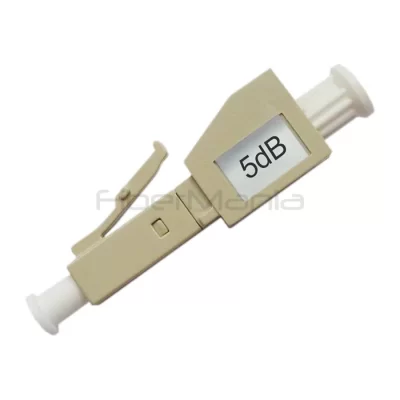
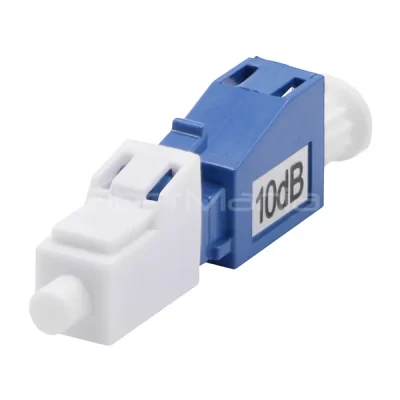
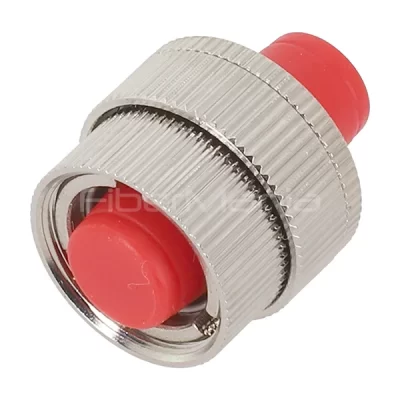
Attenuators come in various forms, including fixed attenuators with a predetermined reduction level (e.g., 3 dB, 5 dB, 10 dB), and variable optical attenuators (VOA), which allow adjustable attenuation for testing, troubleshooting, or fine-tuning network performance.
Why Do Fiber Networks Need Optical Attenuators?
1. Preventing Receiver Saturation
In fiber optic systems, especially single-mode long-distance links, the transmitted signal can be extremely strong. If the light power entering a receiver is too high, the photodetector can become saturated. Saturation may result in signal distortion, data errors, or even permanent damage to sensitive equipment. By inserting an optical attenuator, network engineers can reduce the signal to a level that is safe for the receiver, ensuring reliable communication.
2. Testing and Measurement
Optical attenuators are also invaluable in laboratory and field testing. Engineers use them to simulate signal loss, verify system performance, and calibrate measurement devices. For example, when testing a fiber link, a VOA allows engineers to gradually reduce signal strength and observe how receivers respond under varying conditions. This ensures robust network design before full deployment.
3. Balancing Signal Levels
In complex networks with multiple fiber paths or splitters, the optical signal may not be evenly distributed. Some receivers may receive a stronger signal than others, leading to inconsistencies. Optical attenuators help balance power levels across different receivers, preventing data loss and maintaining network uniformity.
Types of Optical Attenuators
Fixed Attenuators
Fixed attenuation level (e.g., 3 dB, 5 dB, 10 dB)
Simple to install, often inline with fiber connectors
Ideal for systems where signal loss is predictable and stable
Variable Optical Attenuators (VOA)
Adjustable attenuation from 0 dB to 30 dB or more
Used for testing, calibration, and dynamic network adjustments
Allows engineers to fine-tune signal levels in real time
Interface and Fiber Compatibility
Attenuators are available for single-mode (SM) and multi-mode (MM) fibers. Common connector types include LC, SC, FC, and ST, which should match the existing fiber infrastructure. Choosing the right connector type ensures minimal insertion loss and smooth operation.
Practical Example
Imagine a high-speed FTTH (Fiber To The Home) network. The optical line terminal (OLT) at the central office transmits signals to multiple optical network units (ONUs) at subscribers’ homes. Without attenuation, the closest ONUs may receive a signal that is too strong, causing errors or dropped connections. A properly placed optical attenuator reduces the signal strength just enough to ensure all subscribers receive a stable, reliable connection, regardless of distance.
Conclusion
Though small and often overlooked, optical attenuators are the unsung heroes of fiber optic networks. They act as brakes for light, controlling signal power, preventing receiver saturation, enabling precise testing, and maintaining system balance. For engineers and network designers, understanding and correctly implementing optical attenuators is crucial to ensuring the performance and longevity of optical communication systems.
Whether in long-haul single-mode networks, data centers, or fiber-to-the-home deployments, optical attenuators play a pivotal role—proving that even the smallest components can make a huge difference.