Skip to content






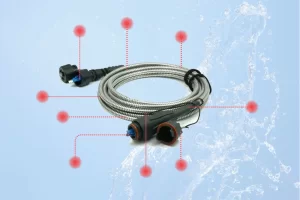






In the evolving world of fiber optic communication, efficiency, integration, and power management have become essential for modern network infrastructures. Among the many innovations designed to meet these needs, hybrid fiber optic cables stand out as one of the most versatile solutions. Combining both fiber and copper conductors within a single sheath, these cables deliver the dual function of high-speed data transmission and power supply, streamlining connectivity across various industrial and telecommunication environments.
This article explores what hybrid fiber optic cables are, their key advantages and applications, and how they differ from other commonly misunderstood cable types such as AOC (Active Optical Cable) and DAC (Direct Attach Copper Cable).

1. What Is a Hybrid Fiber Optic Cable?
A hybrid fiber optic cable integrates optical fibers and electrical conductors in one unified structure.
The fiber cores are responsible for carrying high-speed optical data signals.
The copper wires are used for transmitting electrical power or control signals.
This hybrid design allows both power and data to be transmitted simultaneously over a single cable, reducing the need for separate power and communication lines.
Hybrid cables are sometimes referred to as power over fiber or composite fiber cables, depending on their construction and usage. Their compact design makes them ideal for installations where space is limited and power accessibility is challenging.
2. Structure and Design Features
A typical hybrid cable includes:
Optical fibers: Singlemode (OS2) or Multimode (OM3/OM4), depending on bandwidth and distance requirements.
Power conductors: Usually copper, available in different gauges (e.g., 2×1.5mm², 2×2.5mm²).
Reinforced jacket: Often armored (steel or corrugated) to ensure mechanical strength and environmental protection.
Water-blocking and UV-resistant layers: For outdoor and industrial use.
These design elements ensure that hybrid cables can deliver reliable data and power even in harsh or remote environments.
3. Key Advantages of Hybrid Cables
① Simplified Installation
By combining fiber and power lines into one cable, installation becomes faster and cleaner. Fewer conduits and terminations are needed.
② Cost Efficiency
Using a single cable reduces material, labor, and maintenance costs, especially for large-scale deployments.
③ Extended Reach
Hybrid systems can deliver both data and power to remote equipment—ideal for devices installed far from power sources.
④ Enhanced Safety
Electrical and optical components are isolated to prevent interference and signal degradation.
4. Typical Applications
Hybrid fiber optic cables are widely used in scenarios where both power and data are required simultaneously:
FTTA (Fiber To The Antenna): Connecting Remote Radio Units (RRUs) to base stations in 4G/5G networks.
Surveillance Systems: Powering IP cameras and transmitting HD video signals in long-distance monitoring.
Broadcasting & Stadiums: Supporting cameras, LED displays, and transmission equipment.
Industrial Automation: Delivering data and power to sensors, robots, or control modules.
Marine and Offshore Environments: Where reliability and durability are critical.
5. Hybrid vs AOC vs DAC: Understanding the Differences
| Feature | Hybrid Cable | AOC (Active Optical Cable) | DAC (Direct Attach Copper Cable) |
|---|---|---|---|
| Transmission Medium | Fiber + Copper | Optical Fiber | Copper Twinax |
| Signal Type | Optical + Electrical Power | Optical (Converted from Electrical) | Electrical Only |
| Active Components | None | Yes (Built-in transceivers) | Sometimes (Active or Passive) |
| Typical Distance | 100m – kilometers | Up to 100m | ≤7m |
| Applications | FTTA, Cameras, Remote Devices | Data Centers, Servers | Short-range interconnects |
| Power Delivery | Yes | No | No |
Key takeaway:
Hybrid cables are structural hybrids—physically combining optical and electrical conductors—while AOC and DAC are functional hybrids, combining signal conversion and transmission in active assemblies.
6. Commonly Confused Terms
Composite Cable: Often used interchangeably with “Hybrid Cable,” but technically refers to any cable with multiple types of media (not necessarily power + data).
PoE (Power over Ethernet): Provides power via copper Ethernet cables, but limited in distance and not optical-based.
Active Optical Cable (AOC): Contains transceivers that convert electrical signals to optical and back, but does not carry power.
Hybrid Patch Cable: A small-scale version used for connecting hybrid devices (e.g., power + data ports).
Understanding these distinctions helps avoid confusion when specifying cable types for engineering or procurement.

7. The Future of Hybrid Cabling
As 5G, IoT, and smart infrastructure projects continue to expand, hybrid fiber optic cabling is becoming an essential part of network architecture. Future advancements are likely to include:
Higher power-carrying capacity with lighter materials;
Improved waterproofing and flame resistance for outdoor/industrial use;
Plug-and-play hybrid connectors simplifying installation and maintenance.
By merging power and data seamlessly, hybrid cables enable more efficient network designs and smarter energy distribution—key to next-generation connectivity.
Conclusion
Hybrid fiber optic cables represent a critical step toward integrated, efficient, and scalable communication systems.
By combining optical transmission and electrical power in one design, they reduce complexity, save costs, and enhance performance in demanding environments—from telecom towers to industrial plants.
While terms like AOC and DAC may sound similar, understanding their structural and functional differences ensures you choose the right solution for your application.
For integrators, OEM partners, and system engineers, hybrid fiber technology is not just a convenience—it’s the foundation for the connected future.